TRANSPARENCY AND ACCOUNTABILITY
 CHAIRMAN’S REPORT
 Introduction
I would like to start by expressing my condolences to the
families of those who lost their lives during the labour
unrest at Marikana in 2012. May there never be a repeat
of this tragedy.
To address the imbalance in South Africa’s social
structure will require a huge commitment from
and constructive engagement between business,
government, communities and labour.
During 2012 our many challenges at home, including
labour and community unrest, demands for major
wage increases, excessive increases in electricity
costs and uncertainty around possible mining taxes
and nationalisation of the mining industry discouraged
investors. Unfortunately, at the same time global demand
for commodities was weak. Hopefully, 2013 will see
an improvement in local and global conditions for
our industry.
Safety
The Venture’s safety performance in 2012 was a cause
for celebration with zero fatalities in its operations during
the year. The Venture continues to strive for a major
improvement in all other safety measurements.
Strategy
Merafe takes a long-term view of its business which
we believe allows us to align the interests of all our
stakeholders, something that is not always possible in the
short term.
While our management team has again successfully
implemented most of our strategies, they have still
to implement our diversification strategy. The board
has confirmed its support of this strategy and we
believe Merafe will be well-positioned, once our debt
commitments to our chrome investments are met at the
end of 2013, to pursue its diversification strategy.
Our approach to assurance and sustainability
In my letter to stakeholders on page 1 as well as the
sustainability review and assurance on pages 116 to
117 of this report, we set out the detailed review and
assurance processes which we undertook this year.
We further engaged the services
of Deloittes in 2012 to assist us
in aligning our remuneration with
our strategy and ensuring it is in
accordance with best practice.
JSE SRI Index
Our continued participation in
the JSE SRI Index confirms the
commitment of Merafe and the
Xstrata-Merafe Chrome Venture
to building a responsible business.
We were most disappointed to be
informed that while Merafe had
qualified as a best performer on the
Index the JSE had decided that, given
the significance of the unrest in the
mining industry, it was not possible to
include any mining companies in the
best performer category in 2012.
Management
Stuart Elliot left the company in
May 2012 to pursue other interests.
The board was pleased to appoint
Zanele Matlala, whose experience as
a long-term member of our board, as
both a non-executive and executive
director, gives her a considerable
advantage, as our Chief Executive
Officer.
The board
There were no changes to the
board during 2012, except for the
resignation of Stuart Elliot.
As Chairman of our unitary board
I am responsible for the overall
effectiveness of the board and
its committees and for ensuring
that the board provides effective
leadership, upholds ethical standards,
is responsible, accountable, fair
and transparent and develops
and implements strategies aimed
at achieving our objectives with
regard to our economic, social and
environmental performance. We
have all been working together for
a while and I believe that we work
together very effectively, with all
board members making a valuable
contribution to our deliberations.
There is a clear separation between
my responsibilities and those of
the Chief Executive Officer and this
separation is documented in our
board charter. Our Chief Executive
Officer is tasked with focusing on
the operations of our business and
ensuring it is run effectively and
in accordance with the strategic
decisions of the board.
My thanks to both our non-executive
and executive directors, for the
contribution you have made to the
Merafe board’s deliberations and
decisions during 2012.
Engaging with our stakeholders
Our board is responsible for effective
communication with our shareholders
and we interact with shareholders
at our annual general meetings and
at presentations made by Merafe’s
executive management team when
we release our annual and half-year
results. We have delegated the
responsibility for engaging with our
shareholders and potential investors
to the Chief Executive Officer, the
Chief Financial Officer and the
Investor Relations Manager. Details
of these engagements are included
in the stakeholder engagement
table on the Merafe website at www.meraferesources.co.za
Our plans for 2013
Once again, our industry faces a
challenging year as a result of global
uncertainty and social and economic
factors in South Africa. Our CEO
commented on the threat posed
by chrome ore exports, however,
Merafe remains well-positioned for
the year ahead in terms of a strong
balance sheet and being the lowest-cost
producer in South Africa. The
longer-term future brings with it the
advantage of the ramping up of the
energy-efficient Lion II ferrochrome
plant, hopefully in time to compete
in a period of increased demand for
ferrochrome. Certainly, whatever
happens in terms of the demand
for ferrochrome, this new plant will
increase our competitiveness among
South African ferrochrome producers.
Our chrome interests will not be
requiring futher investments in the
medium term which frees us up to
diversify. Merafe’s empowerment
credentials make it an attractive
potential empowerment partner. Our
recognition as the most empowered
company in the resources sector of
the Financial Mail’s Top Empowerment
Companies survey supports these credentials.
Conclusion
On behalf of the board my thanks
to the entire Merafe team and our
Venture partners for their contribution
to our successes in 2012.
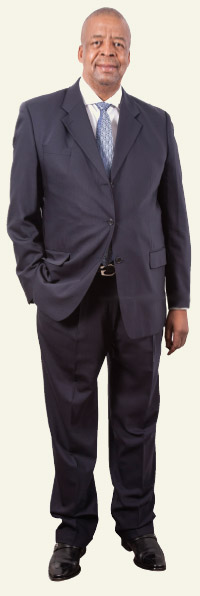
Chris Molefe
Chairman |
|
 GOVERNANCE
Directorate

From left to right: Mfanyana Salanje, Belese Majova,
Abiel Mngomezulu, Chris Molefe, Zed van der Walt, Karabo Nondumo
| |
|
|
|
Mfanyana Salanje (51)
(Independent)
BCom, BCompt (Hons), MBA, CA(SA),
ACMA (UK), HDip Tax Law
Mfanyana, who is currently Chief Executive
Officer of Mfanyana Financial Solutions,
joined the Merafe board as an independent
non-executive director in December 2010.
He has extensive experience in both the
public and private sectors and chairs the
Merafe Audit and Risk Committee. |
| |
|
|
|
Belese Majova (38)
(Independent)
BCompt
Belese joined the Merafe board in
January 2009 as an independent non-executive
director. Currently, she is Chief
Executive Officer of Zeleb Holdings, a
business consultancy specialising in
financial management capacity building
interventions, business process mapping
and supply chain management integration.
Her previous experience includes
holding senior financial and internal
audit management positions. |
| |
|
|
|
Abiel Mngomezulu (59)
(Independent)
BSc (Hons)
Abiel joined the Merafe board as an
independent non-executive director in
September 2010. He is currently the
President and Chief Executive Officer
of Mintek, a state owned enterprise
responsible for mineral extraction
technologies and beneficiation. |
| |
|
Karabo Nondumo (34)
(Independent)
BAcc, HDipAcc, CA(SA)
Karabo, who joined the Merafe board as
an independent non-executive director on
1 December 2010, is currently Executive
Head in the Enterprise Business Unit at
Vodacom Group Limited. She gained her
previous mining industry experience at
Shanduka Resources. |
|
| |
|
Non-executive directors
Chairman
Chris Molefe (64)
(Independent)
BCom, Post-graduate Diploma in
Property Development
Chris, who has chaired the Merafe board
for the past nine years, has extensive
experience in mining and resources,
merchant banking and transformation
strategy development. He is currently
Executive Chairman of Nishati Oil and
Energy Consulting Proprietary Limited.
He is also a non-executive director of
Jubilee Platinum plc and Kiwara plc. |
|
| |
|
Zed van der Walt (68)
(Independent)
PrEng, BSc Engineering (MET),
MBA, DPLR
Zed (66) was the technical director of
Merafe until he retired in February 2008.
Prior to joining Merafe, he was the CEO of
CMI Limited and has 35 years’ operational
and management experience in the
ferroalloys industry. He possesses vast
operational and management experience
and knowledge of the ferroalloys industry. |
|
|

From left to right: Steve Phiri, Mpho Mosweu, Meryl Mamathuba,
Zanele Matlala, Bruce McBride, Ditabe Chocho.
| |
|
|
|
Steve Phiri (57)
BJuris, LLB, LLM, HDip Co Law
Steve was Chief Executive Officer of
Merafe for six years, before becoming the
Chief Executive Officer of Royal Bafokeng
Platinum in in 2011. He remains on the
board as a non-executive director and is a
non-executive director of RBRH. |
| |
|
|
|
Mpho Mosweu (37)
CA(SA), MBL
Mpho Mosweu, who joined our board in
March 2011, is head of the Projects and
Corporate Finance department at the
IDC. She currently serves on the board of
Cipla Medpro, a JSE-listed pharmaceutical
company, as an independent non-executive
director and chairs the company’s audit
and risk committee. She has extensive
commercial and governance experience. |
| |
|
|
|
Meryl Mamathuba (40)
BProc, LLB
Meryl has been a member of the Merafe
board since June 2007. She heads up the
Corporate Funding Department at the
Industrial Development Corporation of
South Africa Limited (IDC). |
| |
|
Chief Financial Officer
Ditabe Chocho (43)
BCom, MSc Financial management,
CA(SA)
Ditabe joined Merafe as Chief Financial
Officer on 2 January 2013. Before joining
Merafe he was Chief Financial Officer of
DSTV Online, a division of MultiChoice,
having previously held the position of
CFO of Multichoice Africa Proprietary
Limited. He sits on the board committees
of Resolution Health Medical Scheme as
chairman of their Audit committee and a
member of their Remuneration committee. |
|
| |
|
Executive directors
Chief Executive Officer
Zanele Matlala (49)
BCom, BCompt (Hons), CA(SA)
Zanele joined the Merafe board in 2005
as an independent non-executive director.
She was appointed Merafe’s Chief Financial
Officer on 1 October 2010 and Chief
Executive Officer in 1 June 2012. She is a
non-executive director of Dipula Income
Fund, Stefanutti Stocks Holdings Limited
and Business Partners Limited. |
|
| |
|
Commercial Director
Bruce McBride (53)
BA, LLB, Dip Advanced Banking,
MBA, PhD
Bruce was a Senior Partner at law firm
Bell, Dewar and Hall before joining Merafe
Resources in 2001 as Commercial Director.
During his time in law he specialised in
commercial litigation, banking and mining
law. He is also a non-executive director of
Mundane World Leaders Fund Limited. |
|
Company Secretary
Amritha Mahendranath (45)
BCom
Amritha, who joined Merafe in 2003
as Financial Manager, was appointed
Company Secretary in 2004. She has a
corporate governance qualification from
the University of Johannesburg and has
completed the GIBS Board Development
Programme. |
|
Senior management
Finance and Investor Relations
Manager
Kajal Bissessor (30)
BAcc, Post graduate diploma in
accounting, CA(SA)
Kajal joined Merafe in 2009. She worked
as a manager at KPMG Inc from 2004 to
2009. During her time with KPMG Inc she
gained international experience as an Audit
Senior with KPMG Ireland. |
|
General Manager –
Merafe Chrome
Dr Jurg Zaayman (44)
BEng, MEng, PhD
(Metallurgical Engineering)
Jurg joined Merafe Resources as
Operations Manager during 2001. In
2004 he was seconded to the Xstrata-Merafe Chrome Venture as project leader
for the Bokamoso pelletising plant project
before being appointed to his current
position in 2007. |
Company Secretary
Our Company Secretary is responsible for administering
the proceedings and affairs of the directorate, the
company and, where appropriate, owners of securities in
the company, in accordance with the relevant laws. The
Company Secretary is available to assist all our directors
with advice on their responsibilities, their professional
development and any other relevant assistance they
may require.
The board has assessed the competence, qualifications
and experience of the Company Secretary, as required
in terms of section 3.84 of the JSE Listings Requirements
and has agreed that she is sufficiently qualified, competent and experienced to hold the position of Company
Secretary. The board made their assessment during a closed
session board meeting. The Company Secretary fulfils
no executive management function and is not a director.
Therefore, the board is satisfied that the Company Secretary
maintained an arm’s length relationship with the executive
team, the board and individual directors in terms of
section 3.84 of the JSE Listings Requirements.
Independent advice
Our non-executive directors can, if necessary, obtain
independent professional advice at the company’s expense.
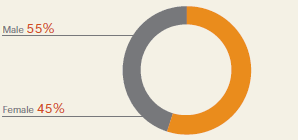
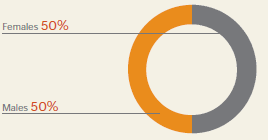
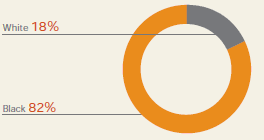
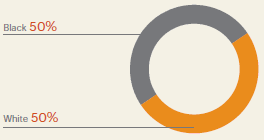
Progression of the racial composition of the Merafe
board since the company’s inception in 2000 |
|
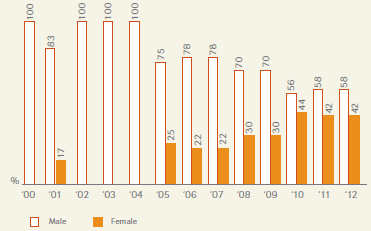
Progression of the gender composition of the Merafe
board since the company’s inception in 2000 |
 |
|
 |
Board statistics as at 31 December 2012
| 45% of our board members are
women, all of whom are black |
|
|
82% of our board members are non-executive directors who do not
receive share options or incentives |
|
82% of our board members
are black |
|
|
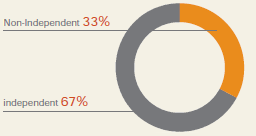
67% of our non-executive board members are independent |
|
|
 |
|
For information on our directors, dealings in securities policy and board
induction and training, retirement and appointment of directors, please see
our website www.meraferesources.co.za |
Details of the members of our board and committees, a summary of their roles and responsibilities and attendance
at meetings by members, as at 31 December 2012, are set out below:
Governance
structure |
|
Roles and responsibilities |
|
Members/Invitees |
|
Attendance |
|
| Board and board committees |
|
|
|
|
|
| Merafe board |
|
The Chairman is responsible for ensuring that:
• the board provides effective leadership
• the board maintains ethical standards.
• Merafe develops and implements strategies aimed at achieving its
sustainability
• the board and its committees are effective
The board is responsible for:
• governance of the Merafe Group on behalf of its shareholders
• its own governance
• strategy and strategic decision-making
• assessment of performance
• engaging with stakeholders
• Merafe’s approach to its social responsibility, safety, health, the environment,
ethics and risk |
|
Chris Molefe
(Chairman) |
|
4/5* |
|
| |
|
|
Zanele Matlala
(CEO from
1 June 2012 and
CFO) |
|
4/5* |
|
| |
|
|
Stuart Elliot (CEO
until 31 May 2012) |
|
2/2* |
|
| |
|
|
Bruce McBride |
|
5/5* |
|
| |
|
|
Meryl Mamathuba |
|
3/5* |
|
| |
|
|
Belese Majova |
|
5/5* |
|
| |
|
|
Abiel Mngomezulu |
|
5/5* |
|
| |
|
|
Mpho Mosweu |
|
3/5* |
|
| |
|
|
Karabo Nondumo |
|
4/5* |
|
| |
|
|
Steve Phiri |
|
1/5* |
|
| |
|
|
Mfanyana Salanje |
|
5/5* |
|
| |
|
|
Zed van der Walt |
|
5/5* |
|
Audit and Risk
Committee |
|
All members of this committee+ are independent non-executive directors (as
required by the Companies Act).
The committee:
| • |
monitors the adequacy of financial controls and reporting; reviews the audit
plans of the external auditors and adherence to these plans; considers and
determines the principles for approving the use of the external auditors for
non-audit services; ensures that financial reporting complies with IFRS and
the Companies Act; and reviews and makes recommendations on all financial
matters |
| • |
oversees Merafe’s integrated reporting as well as the assurance function,
which includes applying a combined assurance model to ensure a
coordinated approach to all assurance activities including sustainable
development and ethics |
| • |
assists the board in the identification of all material risk and sustainability
issues to which the company is exposed. It ensures that the requisite risk
management culture, policies, practices, systems and resources are in place
and are functioning effectively |
| • |
reviews the risks listed in Merafe’s register, as well as those of the Venture, at
each meeting and members are responsible for providing assurance to the
board that risk mitigation processes are in place to reduce the company’s
risk profile |
| • |
is tasked with ensuring that the information technology (IT) strategies of both
Merafe and the Venture are integrated with the entities’ overall business
strategies and processes, that IT is being leveraged to improve their
performance and sustainability and that this forms an integral part of their
risk management practices |
| • |
satisfies itself as to the expertise and experience of the Chief Financial
Officer and the financial functions of Merafe and the Venture |
|
|
Mfanyana Salanje
(Chairman) |
|
5/5 |
|
| |
|
|
Belese Majova
(resigned as
member on
4 May 2012) |
|
2/2 |
|
| |
|
|
Abiel Mngomezulu |
|
4/5 |
|
| |
|
|
Karabo Nondumo |
|
4/5 |
|
| |
|
|
Zed van der Walt |
|
5/5 |
|
| |
|
|
Zanele Matlala+ |
|
5/5 |
|
| |
|
|
Stuart Elliot+ (resigned
31 May 2012) |
|
3/3 |
|
| |
|
|
Bruce McBride+ |
|
4/5 |
|
| |
|
|
Chris Molefe+ |
|
5/5 |
|
| |
|
|
Jurg Zaayman+ |
|
4/5 |
|
| |
|
|
Kajal Bissessor+ |
|
5/5 |
|
Remuneration
and Nomination
Committee |
|
The committee:
| • |
makes recommendations to the board for its consideration and final approval
regarding remuneration strategy and policy |
| • |
assists the board in ensuring that directors and executives are remunerated
fairly and responsibly |
| • |
ensures the disclosure of directors and other executive remuneration is
accurate, complete and transparent |
| • |
assists the board with ensuring that remuneration policies are adopted that
promote the achievement of strategic business objectives and encourage
individual performance and monitoring remuneration policies |
| • |
makes recommendations on non-executive directors’ fees |
| • |
develops policy around the appointment of directors, investigates potential
board members for necessary skills and competence and makes appropriate
recommendations to the board |
|
|
Chris Molefe
(Chairman) |
|
6/6 |
|
| |
|
|
Belese Majova |
|
6/6 |
|
| |
|
|
Karabo Nondumo |
|
5/6 |
|
| |
|
|
Steve Phiri |
|
5/6 |
|
| |
|
|
Zanele Matlala++ |
|
2/3 |
|
| |
|
|
Bruce McBride++ |
|
2/3 |
|
| |
|
|
Stuart Elliot+ (resigned
31 May 2012) |
|
1/2 |
|
Social, Ethics
and
Transformation
Committee |
|
The committee assists the board with the oversight of social, ethical and
transformation matters relating to the company.
It monitors the company’s:
| • |
activities with regard to any relevant legislation, charters or codes in respect
of social and economic development |
| • |
performance in terms of good corporate citizenship including the company’s
promotion of equality, prevention of unfair discrimination, reduction of
corruption, transformation policies and strategies and social responsibility
policies and strategies |
| • |
contribution to the development of communities in which the operations in
which we are invested operate |
| • |
performance in terms of the environment, health and public safety, including
the impact of the company’s activities and its products and services |
| • |
application of its code of ethics and its approach to corruption (as
recommended in principle 1.3 of the King Report on Governance for South
Africa, 2009) |
|
|
Belese Majova
(Chairman from
4 May 2012) |
|
3/3 |
|
| |
|
|
Meryl Mamathuba
(resigned as
Chairman
4 May 2012) |
|
2/3 |
|
| |
|
|
Chris Molefe |
|
3/3 |
|
| |
|
|
Stuart Elliot (resigned
31 May 2012) |
|
1/1 |
|
| |
|
|
Zanele Matlala |
|
3/3 |
|
| |
|
|
Bruce McBride |
|
3/3 |
|
| |
|
|
Jurg Zaayman |
|
3/3 |
|
* There were four paid board meetings, one paid board strategy session and one unpaid board workshop in 2012
+ Invitee
++ Invited to committee from 1 June 2012 |
|
 |
|
For details of the committee’s roles and
responsibilities see the Audit and Risk Committee
report on page 128 |
| Management structure |
|
|
Roles and responsibilities |
|
|
Members/Invitees |
| Executive Committee |
|
|
Our Executive Committee, which meets at least once a month,
recommends policies and strategies; is responsible for the
implementation of strategy and carrying out the board’s mandates
and directives. It deals with all executive management business
and is responsible for all material matters that are not the
responsibility of the board. It also assists the board with the
execution of Merafe’s compliance and disclosure obligations |
|
|
Chief Executive Officer
Chief Financial Officer
Commercial Director |
Xstrata-Merafe Chrome
Venture’s Joint board |
|
|
The Joint board meets quarterly with the aim of ensuring proper
governance of the activities of the Venture. Members of Merafe’s
management team also attend and participate in the Venture’s
monthly Exco, Treasury, Sustainable Development, Audit and
Social and Ethics committees |
|
|
Three senior representatives from
Xstrata and three senior
representatives from Merafe.
Currently, the Chief Executive
Officer of Xstrata chairs the board. |
|
Our approach to governance
We believe that good corporate governance is key to the integrity of our organisation, our ability to manage risk and
perform at optimum levels. It is for this reason that Merafe is committed to the highest levels of ethical and accountable
business conduct. Underpinning our disciplined approach to governance is our determination to ensure we maintain a
balance between good governance and the spirit of entrepreneurship that has built our business.
Our application of King III in 2012
Merafe applies the principles of King III. A table setting out our application of the principles can be found on our website
in the Transparency and accountability section. In 2011, we reported that we had only partially applied some principles
and our application of certain principles was under review. We have made the following progress:
Internal audit
| Oversight of internal
audit in Merafe by
the Audit and Risk
Committee |
|
|
We reported last year that the Merafe Audit and Risk Committee did not oversee internal audit in
Merafe. Since then PricewaterhouseCoopers (PWC) has been appointed as Merafe’s internal auditors.
The scope of their appointment included the preparation of an internal audit plan and an internal
audit charter; reviews of IT governance, legal and compliance and all matters relating to tax. Also
included in PWC’s scope as internal auditors is attendance at all Audit and Risk Committee meetings, as well as meeting with our external auditors |
Governing stakeholder relationships
Management
proactively deals
with stakeholder
relationships |
|
|
As we said last year, while our management team continually strives to improve the effectiveness
of its stakeholder engagement, this remains an area where we believe there will always be room for
improvement |
There is an
appropriate balance
between its various
stakeholder
groupings |
|
|
While we believe that we are reasonably well engaged with all our stakeholder groupings, we still
seek clarity regarding what is meant by “appropriate balance”. In our opinion this issue will also
remain one that needs to be monitored for potential areas where there is room for improvement |
Equitable treatment
of stakeholders |
|
|
Again, we seek clarity regarding the meaning of “equitable treatment”, however, we do believe that
we are doing our best to treat stakeholders fairly. This will also remain an area which we will monitor
for potential areas where there is room for improvement |
Transparent
and effective
communication to
stakeholders |
|
|
While we believe that our stakeholder engagement policies and procedures ensure transparent
and effective communication, we have not, as yet, been able to adequately test this assertion and it
therefore remains an issue we will monitor for potential areas where we can make improvements |
Disputes are
resolved effectively
and timeously |
|
|
We indicated last year that within our agreement with Xstrata regarding the Venture, which is our
major agreement, there are various dispute resolution mechanisms, including an arbitration clause.
As we have not had to refer any dispute for arbitration since the Venture was formed in 2004 we
cannot comment on how effective the process is, or whether disputes are resolved timeously |
The governance of information technology
The board is
responsible
for information
technology |
|
|
PWC is performing a gap analysis in Merafe in their role as internal auditors and their
recommendations in this connection will be implemented. For information on the governance of
information technology in the Venture please see the Risk management report on pages 102 to 103 |
|
|
SOCIAL ETHICS AND TRANSFORMATION COMMITTEE REPORT
| Merafe’s Social, Ethics and Transformation Committee
was established by the board of directors on
21 February 2012, in accordance with the requirements
of the Companies Act of 2008 (the Act), section 72(4) and
Regulation 43(2).
Previously, Merafe had a Transformation and Corporate
Social Investment Committee. The responsibilities of
the Transformation Committee have been incorporated
with this committee’s responsibilities and the committee
has been renamed the Social, Ethics and Transformation
Committee. In addition to the three meetings the
committee held during the year it also held two workshops
on 6 June and 19 October for the purpose of ensuring
that the committee understood its duties and obligations
in accordance with the new legislation. During the
workshops the committee also developed a new charter
and formal terms of reference to replace the previous
committee’s charter and terms of reference. Professor
Deon Rossouw of the Ethics Institute of South Africa
assisted the committee during these workshops. The
committee’s terms of reference will be reviewed annually
by the board.
We would refer you to page 97 for a description of the
roles and responsibilities of the committee and its terms
of reference can be found on our website www.meraferesources.co.za
The committee has an independent role. Its members
include three non-executive directors, two of which are
independent, two executive directors and the general
manager: Merafe Chrome. Independent non-executive
director Belese Majova chairs the committee.
The committee assists the board in monitoring the group’s
activities in terms of legislation, regulation and codes of
best practice relating to:
| • |
ethics |
| • |
stakeholder engagement, including employees,
customers, communities and the environment |
| • |
strategic empowerment and compliance with
transformation codes and is responsible for:
| – |
monitoring the company’s activities relating
to social and economic development, good
corporate citizenship, the environment and health
and public safety |
| – |
ensuring appropriate short- and long-term targets are
set by management |
| – |
monitoring progress on strategic empowerment and
performance against targets |
| – |
monitoring changes in the application and
interpretation of empowerment charters and codes |
| – |
monitoring functions required in terms of the
Companies Act and its regulations. |
|
To meet its responsibilities the committee receives
reports on the progress that both Merafe and the Venture
have made in terms of the issues covered by its terms
of reference. A senior representative of the Venture
attends specific committee meetings where the focus is
on the Venture.
The members of the committee believe that Merafe
is substantively addressing the issues it is required to
monitor in terms of the Companies Act. However, the
committee was only established in the year under review
and we recognise that the functioning and scope of the
committee is a work in progress.
We would refer you to our Governance report, and the
Human and Social capital reports on pages 90, 64 and 82 for more detailed information.
Belese Majova
Chairman |
|
HUMAN RIGHTS AND ETHICS
|
Human rights
Merafe subscribes to the fundamental tenets of human
rights as enshrined in our country’s Constitution and
Bill of Rights. Our policies and practices are aligned to
ensure that all employees and stakeholders are treated
with dignity and in a manner that is culturally appropriate,
irrespective of gender, background or race.
The principles of the UN Universal Declaration of
Human Rights, the ILO Conventions and the UN Global
Compact have been embedded in Xstrata’s Sustainable
Development Framework, which is applied in the Venture.
South African labour legislation prohibits the employment
of children younger than 18 years of age. The Venture’s
operations reported on their adherence to this legislation,
which is monitored through its internal audit and risk
management programme. The age of the youngest
employee in 2012 was 18 years of age.
The Venture has the grievance processes in place
to ensure that any breaches of human rights can be
reported, investigated and, where necessary, the
appropriate corrective action can be taken. In addition,
employees can use the ethics line to report any activities
which they believe are not in line with the company’s
policies on human rights.
Employees of the Venture, and security personnel in
particular, undergo training in human rights to ensure
a basic understanding of, and compliance with, the
Business Principles.
To ensure the highest levels of human rights practice
within the Venture’s supply chain it expects all its major
suppliers and contractors to comply with its Business
Principles and significant business partners undergo
screening on their human rights practices.
The Venture’s Sustainable Development Standards
require its operations to maintain community relations
strategies that uphold and promote human rights and
respect cultural considerations and heritage. No breaches
of human rights were reported by any operations during
2012, nor were there any incidents of the rights of
indigenous people being violated.
Ethics
The Merafe Code of Ethics governs the way we do
business and the way our directors and employees
engage with our stakeholders. The Code, which is binding
on our directors and employees and contractors, provides
guidelines for behaviour which is above reproach.
The Merafe board is committed to creating a culture
where the highest levels of integrity are underpinned
by transparent business transactions and robust
assurance systems.
The Business Principles, which are applied in the Venture,
provide an unambiguous framework within which that
business operates – ethically, openly, responsibly, together
and with others.
A copy of these Principles, in the language of choice, is
provided to every employee, supplier, contractor and
business partner before they begin work at the Venture.
The Principles are an integral part of the Venture’s induction
process which expects strict adherence to these Principles
by both employees and contractors. The Venture uses an
online training system to test employees’ and contractors’
understanding and application of the Business Principles in
a variety of simulated scenarios. Employees are required to
achieve a minimum score of 70% in the training.
Xstrata’s global policy on bribery, fraud and corruption,
implemented in 2010, applies to all subsidiaries, joint
ventures and business units as well as to all employees,
officers and directors of those entities. The purpose of the
policy is to ensure that adequate procedures are in place
to prevent any form of bribery and fraud and to explain the
procedures to be followed by management and staff when
there is evidence or a suspicion of an incident of bribery
or fraud.
To supplement the Business Principles and support this
new policy the Venture developed a new Code of Conduct,
which is issued to all employees and contractors. Training is
provided in the application of the Code.
The Venture’s implementation of the Business Principles
and the Code of Conduct is supported by a confidential
and independently managed toll-free ethics line and email
address, the details of which are printed on the back of the
Business Principles and the Code of Conduct and displayed
in workplaces.
Employees of the Venture can raise concerns over any
unethical business practices including incidences of
fraud, theft, corruption, dishonest business activity,
misappropriation of company resources or incorrect health
and safety practices. These reports are directed to the head
of internal audit for investigation and appropriate action.
Fifty percent of the Venture’s operations underwent human
rights reviews and impact assessments in 2012, 86% of the
Venture’s significant suppliers and contractors underwent
human rights screening and 97% of the Venture’s security
personnel received human rights training.
Venture employees made six formal complaints relating to
human rights. These were addressed and resolved through
formal grievance mechanisms.
Externally developed principles, charters
and initiatives to which Merafe and the
Venture subscribe
Merafe is committed to the principles of the revised Mining
Charter for the South African mining industry and the
Mining Scorecard, established to monitor performance
against the Charter, and to meeting the targets set in the
Mining Scorecard.
Merafe’s partner in the Venture, Xstrata, plays an active role
in a number of significant international and national industry
organisations and stakeholder groups through membership,
funding, provision of expertise and participation in
committees and working groups.
Its commitments, through these involvements, are
met in the Venture’s operations. They include: the UN
Global Compact, the Dow Jones Sustainability Index, the
International Council on Mining and Metals (ICMM), the
North West Province Air Pollution Control Forum (NAPCOF)
and the Ferro Alloys Producers Association (FAPA). NAPCOF and FAPA discuss air quality issues and partner
with regulators in setting best practice air quality standards.
Their task teams deal with specific air quality issues and
also engage with regulators through providing feedback
and advice.
The Venture is a member of the Ferro Alloys Producers
Association (FAPA), the International Chrome Development
Association (ICDA), the North West province Air Pollution
Control Forum (NAPCOF) and the South African Mining
Development Association (SAMDA).
The Venture’s Sustainable Development Framework is
aligned to the International Council of Mining and Metals’
(ICMM) Sustainable Development Framework. |
|
RISK MANAGEMENT
|
Risk management
Risk is an intrinsic aspect of business and is inseparable
from opportunity. The risks set out in the table on pages
104 to 108 represent some of the principal uncertainties
and trends which may have an impact on the Venture and/
or Merafe’s ability to execute their strategies effectively
in the future. These risks have been assessed according
to materiality, likelihood and residual risk after controls
and have been separated into risks from the external
environment and those internal to Merafe and the Venture.
The Merafe board is responsible for the governance of
risk and setting levels of risk tolerance and has tasked
the Audit and Risk Committee with assisting the board in
carrying out its risk responsibilities. While our board has
also delegated the process of risk management in Merafe
to management, the Audit and Risk Committee, acting
on behalf of the board, ensures that there are ongoing
assessment and monitoring of our risks. The Executive
Committee is accountable to the board for designing,
implementing and monitoring Merafe’s risk management
processes and senior managers and heads of department
are responsible for effectively managing risks within their
respective areas of responsibility.
Merafe’s risk management policy and framework
describes our risk management philosophy, approach
and process and guides the implementation of our
risk management process in a uniform manner across
the company.
Many risks inherent in a mining business will always
exist. The challenge is to manage them effectively. The
Venture’s risk management system allows it to pursue
business opportunities and grow shareholder value as
well as developing and protecting its people, assets,environment and reputation. Its processes are defined
within a risk framework that is well understood across
all its operations. Because managing risk is a continuous
challenge, self-assessment is ongoing within the Venture
to identify, evaluate and manage significant risks.
The results are regularly updated on the Xstrata group
risk registers. |
The Venture undertakes a comprehensive annual risk
review, the results of which are implemented into the
annual business plans which are presented to the
Xstrata board for approval. Progress against these plans,
significant changes in the Venture’s risk profile and
actions taken to control and mitigate risks are reported
regularly to its Audit Committee, the Xstrata group Audit
Committee, the Executive Committee and its board.
Information technology governance
Responsibility for the implementation of an IT governance
framework for the Venture has been delegated to the
Business Systems division, which has implemented a
combination of Control Objectives for Information and
related Technology (COBIT), a set of best practices for
IT management; Information Technology Infrastructure
Library (ITIL), a set of concepts and practices for IT
services management, IT development and IT operations;
and Val IT, which is a suite of documents that provide
a framework for the governance of IT investments
produced by the IT Governance Institute (ITGI) and
include a formal statement of principles and processes
for IT portfolio management. Business Systems, with the
assistance of KPMG, has also developed a customised
IT governance framework. The framework has two major
components: the IT governance strategy roadmap and
the IT governance framework, which uses the RACI model
(Responsible, Accountable, Consulted, Informed – a tool
that can be used to identify roles and responsibilities).
Ernst & Young, the Venture’s external auditors and
its internal auditors audit its IT governance
processes annually.
King III has highlighted IT governance and the
responsibilities of the board in this regard. IT is firmly on
the Merafe board’s agenda and as previously mentioned
our internal auditors are carrying out a gap analysis
of IT governance in Merafe. Should the result reveal
weaknesses in our approach we will remedy these.
Within the Venture the Business Systems division reports
into the Chief Financial Officer who represents it at
board level. In addition, the Venture has established a
governance body, the Information Systems (IS) Planning
Council, that reports into Exco and plays a key role in
driving IT governance in the Venture.
To align the operation and management of IT processes
within the Venture with its performance and sustainability
objectives the Business Systems division has aligned its
scorecard with Xstrata’s 17 Sustainable Development
Standards.
A post has been created for the management of IT
risk and to ensure that the Venture’s management of
risk is aligned with Xstrata group risk processes and
methodology.
The management of IT assets is regularly reported to the
IS Planning Council and the Venture’s CFO. In addition,
they are regularly evaluated by means of internal and
external audits. For Merafe IT governance see page 98.
Principal risks and uncertainties affecting Merafe and its investment in the Xstrata-Merafe Chrome Venture
| Risk and impact |
|
|
Mitigation |
| Socio-political climate in South Africa |
| Labour unrest could negatively impact
the Venture’s productivity and
profitability |
|
|
Relationships with and recognition of trade unions; relationships with
employees and establishing employee share option plan (ESOP) |
| If the Venture does not win broad
support for our activities from local
communities, our projects could face
delays, which could impact on
operating profit, development costs
and our reputation. Severe disruptions
would impact on our profitability and
our growth plans |
|
|
Stakeholder engagement plays a very important role in establishing
relationships with our employees and the communities in which we operate,
as does the employment of members of the local communities in our operations. The Venture works with communities affected by our operations
to identify and evaluate their needs and concerns at every stage of a
project’s life cycle, as well as the actual and potential impacts its operations
have on these communities
Merafe and the Venture invest in our social and labour plan commitments,
which include local economic development, healthcare and education
projects. We also invest in corporate social responsibility initiatives |
| Commodity price volatility |
| Negative impact on earnings |
|
|
Our preventive actions include managing production levels, including scaling
down mining and smelting activities during downturns in global demand. In
addition, close relationships with customers and the technical expertise to
predict and plan for upturns and downturns in demand, help Merafe and the
Venture to mitigate the impact of downturns and take advantage of the
opportunities provided by upturns. We also lobby government to protect
the South African ferrochrome industry’s R13 billion investment in
beneficiation capacity |
| Fluctuation in currency exchange rates |
| Currency exchange rate fluctuations
impact on our operating profit |
|
|
We are exposed to rand/US dollar fluctuations. Containing production costs
by means of process improvement initiatives and investments to reduce
costs, helps us mitigate the impact of currency fluctuations in favour of a
stronger rand |
|
|
|
For further information on the socio-political climate see
the Social capital section of this report on pages 82 to 108 and the Operating context section on pages 6 to 7 |
| Risk and impact |
|
|
Mitigation |
| Inability to obtain debt finance |
| A downgrading of Merafe’s credit
status could materially and adversely
affect our financial position and
growth plans |
|
|
At Merafe we maintain a strong balance sheet, low gearing and a good
reputation and relationship with our bankers. We also have tangible assets
to secure financing. We hold regular meetings with our bankers to
proactively assess terms and conditions before potential problems arise.
Our partner in the Venture, Xstrata, takes a considered approach to
debt management |
| Non-compliance and/or changes to laws, regulations, taxes, royalties and mining rights |
| Any non-compliance or changes in
legislation can result in extensive
disruption to operations, loss of
revenue and fines. Loss of mining
rights could affect our business |
|
|
The Venture maintains an extensive, transparent and open relationship with
regulators and local, regional and national government bodies.
The Venture keeps abreast of all changes to legislation and ensures any
changes to laws or regulations are addressed and we closely monitor
compliance with legislation. The Venture works in partnership with its
employees and local communities in order to earn and maintain our social
licence to operate. Merafe maintains an extensive, transparent and open
relationship with regulators and local, regional and national government
bodies. We follow and implement any changes to laws or regulations and
closely monitor compliance with legislation. We are on track to achieve the
Mining Charter targets, including our employment equity, procurement and
social development targets. Merafe and the Venture regularly engage with
SARS, DTI, DMR and other regulators |
| Investors’ negative perceptions of the South African mining industry |
| This could impact on investors’
appetite for investment in South
African mining stocks |
|
|
Merafe focuses on maintaining relationships with our existing investors
and building new relationships. To achieve this our team regularly travels
to Europe, the United States and Asia to meet with and make presentations
to European, American and South African investors and potential investors
to address any concerns. We also keep investors informed through
our website |
| Health of global economy |
| The possibility of a meltdown in the
Eurozone could impact on South Africa
and South African companies |
|
|
We need to maintain our position as the lowest-cost ferrochrome producer
in South Africa and have the flexibility to react quickly to changing
economic circumstances |
| Loss of key and skilled employees in Merafe and the Venture |
| Loss of key and skilled employees,
particularly to competitors, could result
in financial loss and reputational
damage |
|
|
Our policy is to invest in future key contributors and to implement
adequate notice periods and lock-ins through deferred bonus payments
and share incentives |
| Empowerment credentials |
| Loss of empowerment credentials
if Royal Bafokeng Resources
Holdings Limited (RBRH) sell their
shares in Merafe |
|
|
The mining industry is governed by the Mining Charter which requires
mining companies to have empowerment credentials. RBRH has been a
shareholder in Merafe for over ten years. Merafe ensures RBRH is kept
informed, regularly meets with its representatives and RBRH is represented
on the board |
| Operational risks |
| The Venture’s operations are affected
by a number of factors that are
outside our control. These include the
availability and costs of raw materials,
water and power, unusual ground
conditions, climatic conditions
resulting from climate change (e.g.
drought or flooding)
These factors could adversely affect
our operating performance, production
levels, unit costs and operating profit |
|
|
The Venture has in place a comprehensive programme to identify,
understand and manage the risks that affect our business and our
operations. We undertake an annual risk review, and the risk registers
of Xstrata, Merafe and the Venture are regularly updated |
| Chrome ore |
Chrome ore exports to China could
undermine the South African
ferrochrome industry and the
beneficiation of chrome ore in
South Africa |
|
|
The Venture and the ferrochrome industry are engaging with government to
develop a solution that will support government’s beneficiation and job
creation strategies and ensure the sustainability of South Africa’s
ferrochrome producers |
| Cost control |
The Venture’s competitiveness and
long-term profitability depend
significantly on our ability to maintain
low-cost efficient operations. Above
inflation increases in input costs may
negatively impact Merafe’s earnings |
|
|
We pride ourselves on being a low-cost producer. Cost performance is
regularly reported to the Executive Committee and is a key management
performance measurement. The Venture’s development of lower-cost
proprietary technology has played a significant part in cost reduction. We
are also engaging with government regarding carbon taxes, electricity costs
and steps to ensure the sustainability of the ferrochrome beneficiation
industry in the future |
|
|
|
More information on stakeholder engagement is
available throughout this report |
| Risk and impact |
|
|
Mitigation |
| Security of energy supplies |
| Lack of energy supply could impact on
the Venture’s ability to operate or
threaten planned future expansion of
our operations or the development of
new mines |
|
|
The Venture has an ongoing programme to assess and monitor energyrelated
risks, including scenario analyses. We manage the risk through
implementing energy efficiency plans and assessing the risks associated
with energy supply at the design phase of our projects. Our investment in
process technology to achieve efficiencies and reduce energy consumption
has allowed us to become the lowest-cost ferrochrome producer in
South Africa |
| Emissions and climate change regulation |
| There is uncertainty concerning carbon
taxes and the interpretation and
application of any legislation relating to
these taxes in South Africa
They may have a material adverse
impact on our ability to maintain
profitability
Water scarcity has also become a
global issue and could in future affect
the Venture’s ability to operate |
|
|
The Venture continually engages with government and key policymakers to
advocate a rational approach to carbon taxes
We have made climate change issues a high priority and the Venture
reviews climate change strategy regularly. We have reduced the carbon
emissions attributable to the electricity we purchase by improving the
energy efficiency of our operations and investigating the use of renewable
energy sources. The Venture is undertaking feasibility studies on a number
of potential energy efficiency projects. + The Venture’s emissions are
reported to the Carbon Disclosure Project (CDP)
The Venture has successfully taken steps to reduce its water consumption |
| Health, safety and the environment |
| The Venture’s operations are subject to
extensive health, safety and
environmental (HSE) regulations and
legislation and community
expectations
In South Africa HIV and AIDS and
associated diseases remain the major
healthcare challenges facing our
industry
Any breach of regulations or noncompliance
with the Venture’s own
best practice standards in health,
safety and environmental performance
and community relations could affect
our licence to operate
If the Venture’s employees suffer from
the symptoms associated with HIV and
AIDS, it could have a negative impact
on the Venture’s production levels and
our profitability |
|
|
We give these three issues priority and significant resources are committed
to providing a safe and healthy workplace, keeping our impact on the
environment to a minimum and addressing the impact of HIV and AIDS on
our employees and the communities in the vicinity of our operations
All operations are regularly independently audited through the Sustainable
Development Assurance Programme and they manage the risks that could
affect the Venture’s operations
|
|
|
|
For more information on climate change and the
environment see the Natural capital section pages
40 to 49 |
| Risk and impact |
|
|
Mitigation |
| Project development |
| The Venture’s ability to develop our
project pipeline and expand our
operations with new, lower-cost
operations will impact future revenues,
costs and its reputation for successful
project development |
|
|
Cost control is a key consideration in project development and the Venture
has an excellent track record of delivering major capital growth projects on
time and on budget. We have a comprehensive project approval process
which governs project management at each stage of a project. Approval
processes ensure that all risks are fully assessed and, where possible, are
mitigated before the project can proceed to the next phase |
| Reserves |
| Our mine reserves decline as chrome
ore is extracted and not all reserves
may be mined as profitably as
originally anticipated. In order to
develop reserves, mining rights must
be obtained for our chrome ore mines
Successful exploration and
development activities and access to
new properties containing
economically recoverable reserves are
important to the Venture’s future
success. If it cannot obtain the
necessary exploration and mining
rights, our ability to develop reserves
will be adversely affected |
|
|
The Venture annually updates the quantity and quality of our estimated
proven and probable reserves to reflect the extraction of chrome, additional
drilling or other data. Our policy is to ensure five years of proved ore
reserves at any time. The Venture continually investigates alternative
sources of supply of chrome ore, the acquisition of additional reserves and
the possibility of exploiting alternative seams within its existing mines, such
as MG4. The Venture has also secured UG2 supply agreements with
platinum producers. The Venture is well-positioned in terms of the
conversion of its mining rights as set out in the Mineral Resources and
Reserves section of this report |
|
|
REMUNERATION REPORT
| Our remuneration philosophy
Merafe’s primary remuneration intent is to employ and
reward high calibre and high performing employees
who subscribe to the values and culture of our company.
We recognise that our employees are integral to the
achievement of our corporate objectives and that they
should be remunerated accordingly for their contribution,
and the value that they deliver. Additionally, non-executive
fees should be determined in the context of good
governance and be market-related.
Our remuneration strategy
Our remuneration strategy is designed to be aligned with
our business strategy and its execution. As we strive
to attract, retain, motivate and reward employees for
executing our business strategy, their remuneration must
clearly be market-related, and our Remuneration and
Nomination Committee uses third parties for the purpose
of benchmarking to the appropriate segment. The general
principle of this strategy is to structure executive and
employee remuneration to provide:
| • |
guaranteed annual salaries and benefits that are
commensurate with the market for key talent |
| • |
annual cash incentives that reward short-term
operational performance |
| • |
long-term (share-based) incentives that promote
retention and drive performance in alignment with
shareholder goals |
The Remuneration and Nomination Committee
Responsibility for the company’s remuneration policies
rests with the Merafe Resources Limited board of
directors, which has in turn appointed the Remuneration
and Nomination Committee.
The committee comprises at least three members, all
of whom are non-executive directors. The Chairman
of the committee and the majority of its members are
independent. The committee is governed by formal terms
of reference approved by the board.
The primary role of the committee is to ensure that the
company’s directors and senior executives are paid
fairly for their individual contributions to the company’s
performance, and that remuneration policies are
appropriate to attract, retain and motivate quality directors
and senior management, committed to achieving the
overall goals of the company.
This role essentially consists of:
| • |
assisting the board in setting and monitoring
remuneration policies which promote the achievement
of strategic business objectives and encourage
individual performance |
| • |
ensuring that remuneration policies are adopted
and reviewed and aligned with the strategy of the
organisation and linked to individual performance |
| • |
reviewing the outcome of the implementation of the
remuneration policy. |
Additionally the committee plays an active role in
succession planning activities, notably for the Chief
Executive Officer and executive management.
The committee is responsible for making
recommendations to the board on remuneration policy
for the directors and, to the extent it deems necessary,
makes external comparisons between remuneration
packages currently available to the company’s own
executive directors and those available to directors
of other companies of a similar size in the comparable
industry sector.
The committee meets formally at least two times a year,
and a quorum is set at three members being present. The
Chairman of the board and the CEO attend meetings to
discuss the performance of other executive directors and
to make proposals as necessary.
The Chairman of the committee may meet with the
CEO and the Company Secretary to discuss important
issues and agree on the agenda. The CEO, other senior
employees, professional advisors and board members
may attend the meeting by invitation only, but they may
not vote. The Company Secretary is the secretary of
the committee.
The board performs an evaluation of the effectiveness of
the committee on an annual basis.
Remuneration policy
The key principles of Merafe’s remuneration policy are:
| • |
Policy is governed by the Remuneration and Nomination
Committee who regularly review all policies to ensure
that they are relevant and support company strategy |
| • |
Guaranteed remuneration is targeted at the median to
upper quartile of the relevant market data |
| • |
All employees are members of medical and retirement
funds and have group life and disability cover |
| • |
Variable pay is an important component of remuneration
and both annual and long-term performance-based
schemes are in place in support of the company’s
business strategy |
| • |
Incentive scheme performance measures are assessed
by the Remuneration and Nomination Committee. These
measures are weighted between corporate, individual,
and financial and non-financial criteria |
| • |
Performance measures are applicable to the time
period to which the scheme relates |
| • |
Annual cash incentive bonuses are based on
performance for the financial year, while the long-term
incentive scheme measures are based on long-term
sustainability and shareholder value |
| • |
Annual salary adjustments are governed by factors such
as the consumer price index (CPI), retention strategies,
the producer price index (PPI), industry performance,
projected growth, contractual arrangements and
affordability |
| • |
Industry average increase surveys are taken into
consideration in setting increases |
| • |
Both short-term and long-term incentive schemes are
benchmarked against practices at similar companies |
| • |
The over-riding principle governing payments for non-executive
directors is that they are made in the context
of good governance. |
|
|
|
For more information on our performance against
strategy see the Chief Executive Officer’s review on
pages 16 to 23 |
Executive remuneration
The Remuneration and Nomination Committee (assisted
by independent advisors) has reviewed Merafe’s
remuneration policy and has recently approved a new
policy which is in line with best practice and which is more
aligned with the company’s strategic objectives.
The major change in policy has been to move away from
bonuses based solely on a 1.5% share of EBITDA towards
a more balanced approach, which addresses the long-term
sustainability of performance rather than merely
rewarding short-term financial performance.
Executive pay mix
Executive pay mix is defined as the balance targeted
between the major components of executive
remuneration, namely:
| • |
Guaranteed pay – based on total guaranteed cost to
company (tctc), being the combination of basic salary,
allowances and benefits |
| • |
Performance variable pay, being made up of:
– on target reward from short-term incentives in the
form of annual cash incentives
– the expected value from long-term (share-based)
incentives.
|
Note: Expected value is defined as the present value of the
future reward outcome of an offer, given the targeted future
performance of the company and of its share price. It should
not be confused with the term “fair value” which is used when
establishing the accounting cost for reflection in a company’s
financial statements. Neither should it be confused with the
term “face value” which is used to define the current value of
the underlying share at the time of an offer.
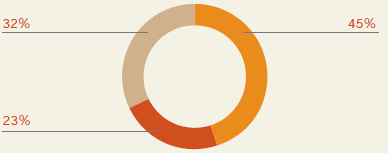
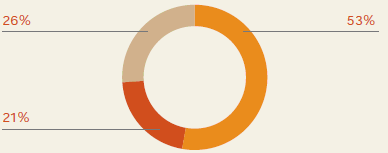
The balance between guaranteed pay (total cost to
company), targeted annual cash incentives and the
expected value from long-term (share-based) incentives
for executives is shown in the pie charts below and on the
next page.
| Relative apportionment between
the major elements of reward |
|
|
| Chief Executive Officer |
|
Executive director |
 |
|
 |
 |
|
|
Executive and employee remuneration principles/structure
Note that, through acquisitions and business combinations
over time, and due to the impact of individual and business
performance, actual pay mix will inevitably deviate from the
targeted pay mix structure.
Merafe’s executive remuneration (see the diagram above
setting out the major components) aims to align employee
incentives with the interests of our shareholders. Details of
executive and management remuneration in 2012 can be
found on page 179 to 180 of this report.
Guaranteed remuneration
Merafe aims to establish and maintain an integrated pay
line with pay levels that ensure that it is able to remain
competitive while managing costs. Salaries and benefits
are reviewed annually and are targeted broadly at the
median position in the relevant market. The company
conducts annual market pricing exercises against the top
management reward surveys. The benchmark used is the
median total guaranteed cost of employment for similar
positions in similarly sized, listed companies. When deciding
on salary reviews the Remuneration and Nomination
Committee also takes into account business performance,
salary practices prevailing for other employees in the
company and, when setting individual salaries, the
individual’s performance and experience in the role.
Short-term incentives
Merafe’s annual incentives are aimed at rewarding a
combination of both business and individual performance.
Business performance (a weighted combination of financial
performance and key strategic metrics) determines the
size of a bonus pool for the company and individual
contributions to this performance (measured in terms of
individual value driver scorecards) determine the bonus
pool’s distribution to individuals.
Business performance is assessed in terms of a select
scorecard of performance indicators, covering both
financial and non-financial elements. Actually achieved
performance against targeted EBITDA is given a weighting
as is the achievement of additional ferrochrome business
and/or targeted diversification (as submitted in a body
of evidence and approved by the Remuneration and
Nomination Committee). These metrics are assessed
against a five-point scale.
The percentage split between targeted EBITDA and the
achievement of additional ferrochrome business and/or
targeted diversification will be discussed and agreed by the
Remuneration and Nomination Committee annually, but is
currently set at 50%/50%.
Long-term (share-based) incentives
The intention behind the offer of long-term (share-based)
incentives is both to reward employees, including
executive directors, for long-term performance and
shareholder alignment, and to serve as a retention
mechanism for employees whose services are regarded
by the company to be crucial to its future growth and
sustainability.
Share incentive schemes
On 14 December 1999, Merafe’s shareholders approved
a share option scheme for employees (including
executive directors) of the company and its subsidiaries
to encourage employees to identify more closely with the
activities of the company and to promote its continued
growth by giving them an opportunity of acquiring shares
in the company.
All options vest one third per year on the third, fourth and
fifth anniversaries and are settled by physical delivery
of shares against receipt of payment of the option price.
These options lapse if not exercised after 10 years
by employees and options are forfeited when an
employee resigns from the group not having exercised
his/her options.
On 13 April 2010 a new share incentive scheme was
approved by shareholders providing for offers of
both share options and full value (free) shares. The
offers of full value (free) shares were split 50%/50%
between performance-oriented awards being subject to
performance vesting conditions and retention-oriented
grants with no performance conditions other than
continued employment.
All offers vest in equal tranches on the third, fourth and
fifth anniversary and are settled by physical delivery of
shares. Alternatively, the company has the right to settle
the value accruing to an individual via the payment of an
equivalent value cash bonus.
The conditions applicable to the performance-oriented
awards are set out on page 158 of the annual financial
statements.
The board of directors of the company, on the
recommendation of the Remuneration and Nomination
Committee, made various offers of share options and full
value (free) shares during 2010, 2011 and 2012.
In 2012 the Remuneration and Nomination Committee
made a decision to vary the balance between performance-oriented
awards and retention-oriented grants and to
simplify the performance criteria that determine vesting of
the performance-oriented awards. From 2013 awards will
be governed by a single performance metric that compares
Merafe’s total shareholder return over a three-year period
with that of a selection of JSE-listed small cap mining and
resources companies.
The fundamental principles governing Merafe’s revised
long-term incentives are as follows:
| • |
Share options are only offered at the discretion of
the board |
| • |
Full value share offers are made annually to all
employees, the targeted reward of which is dictated by
the company’s reward strategy – pay mix |
| • |
Performance-oriented share awards and retentionoriented
grants are offered to senior managers and
above, with the proportion of awards, in relation to
grants, increasing with seniority |
| • |
Performance-oriented award values are calculated as
a percentage of an individual’s total cost to company
guaranteed package |
| • |
Retention-oriented grant values in any one year are,
at the discretion of the board, calculated either as
a percentage of the current total cost to company
guaranteed package, or as a percentage matching of
the past year’s annual incentive payout. |
Share options and share awards and/or grants offered to
directors under the share incentive scheme during 2012
are set out on pages 159 to 161 of this report.
Unvested share options and share awards and/or grants to
directors are set out in the tables on pages 157 to 161 of
this report.
Non-executive directors’ fees
In accordance with Merafe’s policy of ensuring that
non-executive directors’ fees are market related, the
company consults regularly with independent experts
regarding the appropriate fee structures and levels, the
last review having been undertaken in 2012.
The fees for non-executive directors are provided in the
context of good governance, and in line with the strategy
of attracting and retaining high calibre individuals as
custodians of the company’s business.
Fees are primarily derived from a methodology which
takes into account expertise, the contribution made by the
director, and attendance. Independent benchmark advice
is sought and the present policy is that non-executive
directors’ fees are positioned midway between the median
and upper quartile of those fees found in listed companies
of a similar size. The fees vary according to the different
roles, such as Chairman, that non-executive directors
undertake in the various committees.
To avoid any conflict of interest, non-executive directors
do not and will not participate in any share-based incentive
scheme or any other incentive scheme that the company
may implement.
Non-executive directors’ fees are tabled annually for
approval by the shareholders of the company. The non-executive
directors’ fees paid during 2012 are set out
below, as are the proposed non-executive fees for 2013.
Details of non-executive directors’ remuneration in 2012
can be found on page 179 of this report.
Fees are based on four meetings a year with a split of
a 60% retainer and a 40% attendance fee. In addition,
attendance fees only are payable for special board or
committee meetings. Should the Chairmen of the board
and committees be required to undertake ad hoc duties,
additional remuneration is payable for the time spent, in
accordance with Merafe’s remuneration policy and as
determined by the board.
Non-executive directors’ fees for 2012
| |
Fees
per annum
R |
|
Retainer
60%
R |
|
Attendance
fee 40%
R |
|
Fee
per meeting
R |
|
| Board Chairman |
407 570 |
|
244 542 |
|
163 028 |
|
40 757 |
|
| Board members |
219 685 |
|
131 811 |
|
87 874 |
|
21 968 |
|
| Audit and Risk Committee Chairman |
115 699 |
|
69 419 |
|
46 820 |
|
11 570 |
|
| Audit and Risk Committee members |
104 887 |
|
62 932 |
|
41 955 |
|
10 489 |
|
| Remuneration/Nomination Committee Chairman |
85 701 |
|
51 421 |
|
34 280 |
|
8 570 |
|
| Remuneration/Nomination Committee members |
52 311 |
|
31 387 |
|
20 924 |
|
5 231 |
|
| Social, Ethics and Transformation Committee Chairman |
85 701 |
|
51 421 |
|
34 280 |
|
8 570 |
|
| Social, Ethics and Transformation Committee members |
52 311 |
|
31 387 |
|
20 924 |
|
5 231 |
|
Proposed non-executive directors’ fees for 2013 (a fee increase of 7% on non-executive directors’ fees for 2013 is
proposed with the exception of the Chaiman: Audit and Risk which has been increased to R191 500 after a benchmark
exercise was performed to evaluate whether the current fees are market related)
| |
Fees
per annum
R |
|
Retainer
60%
R |
|
Attendance
fee 40%
R |
|
Fee
per meeting
R |
|
| Board Chairman |
436 100 |
|
261 660 |
|
174 440 |
|
43 610 |
|
| Board members |
235 063 |
|
141 038 |
|
94 020 |
|
23 506 |
|
| Audit and Risk Committee Chairman |
191 500 |
|
114 900 |
|
76 600 |
|
19 150 |
|
| Audit and Risk Committee members |
112 229 |
|
67 337 |
|
44 892 |
|
11 223 |
|
| Remuneration/Nomination Committee Chairman |
91 700 |
|
55 020 |
|
36 680 |
|
9 170 |
|
| Remuneration/Nomination Committee members |
55 973 |
|
33 584 |
|
22 389 |
|
5 597 |
|
| Social, Ethics and Transformation Committee Chairman |
91 700 |
|
55 020 |
|
36 680 |
|
9 170 |
|
| Social, Ethics and Transformation Committee members |
55 973 |
|
33 584 |
|
22 389 |
|
5 597 |
|
| Based on four meetings a year with a split of 60% retainer and 40% attendance fee |
|
 |
|
|
|


 Letter to stakeholders