 |
 |
 |
|

 Letter to stakeholders
| Currently viewing: Environment / Next: Mineral resources and mineral reserves |
|


ENVIRONMENT
As Merafe’s corporate office has a limited impact on the environment this section of our report focuses on the Venture’s environmental approach, impact and performance. Previously, we have relied on the Venture’s effective environmental policies and procedures to ensure our investment is managed responsibly. Merafe is now in the process of developing its own environmental policy which will apply to any future investments we make. Stakeholder impact When it comes to the environmental impact of the Venture’s operations, the communities where it operates are important stakeholders, as its operations could affect their access to water and the quality of this water, and its emissions to air could affect the health of community members. If its waste management is poor it could pollute their environment and if its management of biodiversity and its use of the land it occupies is poor it could damage habitats and destroy threatened species. The Department of Environmental Affairs (DEA), the Department of Water Affairs (DWA) and the Department of Mineral Resources (DMR) are responsible for monitoring the Venture’s adherence to environmental legislation and its progress against its environmental targets in terms of the Mining Charter Scorecard. The communities in which the Venture works, and in particular the forums representing these communities, which include the North West Eco Forum and the Kroondal Eco Forum; the DEA, the DWA and the DMR; and a number of industry bodies, including the North West Air Pollution Control Forum (NAPCOF), the International Stainless Steel Federation (ISSF), the International Chrome Development Association (ICDA), the International Council for Mining and Metals (ICMM) and the Global Business Coalition programme, in which Xstrata is either a member or a participant, all have an impact on the Venture’s ability to manage the environments in which it works. The government departments have to approve its environmental and social impact assessments (ESIAs) and issue its water use licences, without which it cannot operate. Merafe’s investors could be affected if the Venture cannot operate without a licence and if it incurs major environmental fines or penalties. Engagement with stakeholders The Venture engages with communities through open days and community forums, which provide an opportunity for community members to gain an understanding of its processes and the steps it is taking to improve its environmental performance. The Venture also invites community members and community forums to record any complaints or concerns. A complaints register is available at every operation for this purpose. These complaints/concerns are addressed and the Venture gives feedback on the actions it has taken. The Venture’s operations have quarterly meetings with the community forums. It sends SMS messages to their members whenever there is a venting incident at one of its smelters and it includes information on its actions to address the result of the incident. It also communicates via emails. The Venture’s regular engagement with the DEA and the DWA by means of workshops, working groups, forums and meetings allows it to share best practice, discuss industry issues, give input into proposed legislation and share environmental knowledge. Its participation in industry bodies through membership of committees, co-development of research projects and presentations gives it access to information on common problems, best practice and performance trends and allows it to share information on product stewardship. An integrated approach to environmental responsibilities While the Venture manages the environmental risks and impacts of its operations through Xstrata’s group-wide environmental risk and performance management framework, it tailors its approach to environmental management to its specific operational and business management processes, while remaining consistent with the commitments and specifications of Xstrata’s group-wide sustainable development and risk management frameworks. Management accountability is central to Xstrata’s integrated approach. Every year Xstrata reviews its environmental risks and opportunities as part of its business strategy and planning process. It captures and integrates environmental risks into its site, divisional and commodity business unit and group-level risk registers. This approach involves the whole management team, not just its environmental specialists, in the analysis and treatment of environmental risks and performance. Xstrata’s sustainable development assurance programme, which aligns with ISO 14001 and the International Council of Mining and Metals’ (ICMM) Sustainable Development Principles, requires independent site audits in the Venture every three years. These audits, undertaken by specialists, include assessments of both environmental management systems and risks. Each site uses the findings from these audits when they prepare their annual sustainable development improvement plans. The Venture’s executive team tracks and reviews these plans. Site specific environmental compliance and system audits are used to identify opportunities to improve environmental management at the Venture’s sites. The Venture’s employees are trained in risk management and environmental awareness. Minimising impacts The Venture is committed to identifying, understanding and minimising its impacts throughout the life of its operations and rehabilitating land once its operations have ceased. Xstrata’s Sustainable Development Policy, which is applied in the Venture, outlines its commitment to identifying, understanding and mitigating the negative environmental impacts of its activities. The Venture focuses on identifying and using opportunities to help protect and improve the environment by, for example, creating protected areas for biodiversity-rich habitats on the land that it owns or leases. It recognises that mining activities affect land, water and air and believes there is a great deal that it can do to mitigate these impacts and to ensure that they are not long term. Managing emissions The Venture’s mining and metal processing operations generate air emissions that have the potential to affect communities living nearby and local ecosystems, if they are not carefully controlled and managed. One of its biggest concerns is particulate matter (dust which is sometimes contaminated with metals). The Venture reduces its emissions to air from its smelters to a point where they do not significantly affect air quality. The total particulates generated by the Venture’s operations during 2012 were 26% lower than those we generated in 2011 as a result of the Rustenburg ferrochrome plant not operating for six months. The total mass of oxides of nitrogen (NOx) produced by our smelting processes was increased by 40% and that of our oxides of sulphur (SOx) was increased by 8%. Waste The Venture’s operations generate significant amounts of hazardous and non-hazardous waste which, unless properly disposed of, can be a threat to the environment. The costs of waste disposal can be high. The Venture does not transport, import, export or treat waste deemed hazardous under the Basel Convention Annex I, II, III and VIII. All its operations are required to have waste management strategies and plans in place to reduce, reuse, recycle and properly dispose of the waste they generate. This minimises the amount of waste sent to landfill and cuts costs. Metallurgical mines and smelters produce distinct wastes that need to be dealt with in a specific manner. |

How the Venture disposes of waste also depends on the local opportunities to recycle or reuse waste. Accredited service providers dispose of the waste the Venture is unable to recycle in a responsible manner. Materials currently recycled include scrap metal, paper, wood and conveyor belts. The largest volume of waste the Venture produces is mineral waste, which includes waste rock removed to expose ore. This waste can be placed in disused opencast or underground operations, reused during site rehabilitation or stockpiled. Tailings and slag from processing ore and concentrates, are recycled or reused whenever possible. The Venture’s emissions
Mineral waste
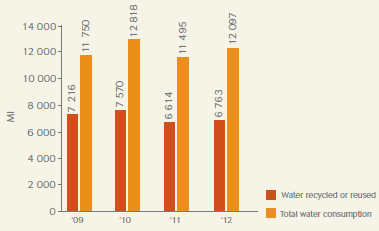
The Venture recycles UG2 ore, a waste product of the platinum refining process, using it to make chromite pellets which are used in its ferrochrome smelters. Effluents All the Venture’s operations are zero-effluent discharge operations. In terms of our licence conditions and requirements we may only discharge effluent in an emergency and in consultation with the relevant authorities. Management of overburden, rock, tailings and sludge/residues The Sustainable Development Standards and guidelines applied in the Venture’s operations set stringent expectations for the management of tailings and waste rock facilities. Tailings from its operations are generally stored in specially designed dams during the life of the operation. The Venture prioritises the maintenance of the integrity of tailings dams, as even a small amount of leakage could negatively impact local water quality, and takes great care in their design and management. It has processes in place to ensure it continually checks the structural capacity of these dams and to monitor ground waste. The Venture stores waste rock in dumps, which it rehabilitates by shaping rock piles and revegetating them to mimic the natural environment. Water Water is a finite and precious natural resource essential to the sustainability of the communities in which the Venture works. It is also necessary for its mining and metallurgical processes. Redefining water use The Venture aims to use water as efficiently as possible and to avoid any negative impacts on water quality in the environments in which it works. Its water use includes water employed in its primary activities, which are mining and smelting, and in its non-primary activities such as dust control and garden maintenance. The Venture mainly sources the potable water it uses in its operations from a variety of water service providers, including local municipalities. Previously, all water used in dust suppression and plant usage from dirty water onsite was considered recycled, as this water was captured onsite and reused in the activities onsite. The Venture has since revised how it defines recycled and dirty water from onsite dewatering activities. Essentially, it captures all rainwater that falls on “dirty areas” and stores it for use in onsite activities such as dust suppression. Water usage measurement is an evolving area and the Venture continues to refine how it measures water usage and its collection processes, in order to meet its evolving management and reporting needs. Water use and availability The Venture’s operations work with the Department of Water Affairs, local communities, local authorities, the farming community and other industry users to ensure the sustainability of water resources and equitable access to water resources for all stakeholders. The availability of water is a key consideration when the Venture plans the expansion or construction of an operation. It uses the results of the ESIAs it undertakes to guide its decision-making and to ensure it has the least possible impact on local water resources during the various phases of its projects.
All the Venture’s operations have water conservation plans. They have previously set water intensity targets and have measures in place to help them be as water efficient as possible. In addition its operations are identifying possible water reduction projects. The only water sources sensitive to withdrawal in the Venture’s operations are the Dwars River and the licensed boreholes at the Lion ferrochrome plant. Incidents and compliance It is always the Venture’s aim to have no environmental incidents at its operations. It monitors, reports, investigates and remediates any incidents that occur and applies lessons learnt to prevent similar events in the future. Its operations are required to report any environmental high potential risk incidents (HPRI), including near-misses, that could have resulted in a category 4 or 5 incident, even when the actual impact was less significant. Environmental incidents recorded at the Venture’s operations include incidents that occur as the result of contractor activity. Progress The Venture has had no environmental fines, penalties or prosecutions at its operations for the past five years. The Venture achieved its goal of no category 3, 4 or 5 incidents recorded in its operations in 2012 and no category 4 or 5 incidents were recorded in the Venture’s operations for the past six years. Environmental incidents
Biodiversity and land management Xstrata maintains a trust fund which contains a sum equivalent to its estimate of the future costs of rehabilitating the sites it manages over their operational lives. The Venture does not have any areas of high biodiversity on the land it owns, leases or manages. Planning for rehabilitation and restoration The Venture annually estimates the future costs of rehabilitation and bases the value of the trust fund it maintains on these estimates. Its careful planning, management and investment in its resources ensures that it rehabilitates and restores its mine areas to an ecological status very similar to the conditions that existed before its mining activities began. The Venture also manages waste rock and closed mines to prevent acid rock drainage occurring. It considers the impact of its operations on local landscapes across the life cycle of a site, from initial exploration to decommissioning and closure. Identifying potential impacts The Venture conducts baseline biodiversity and landscape function studies as part of its ESIAs of all its projects. They are undertaken during the feasibility or exploration phase of a project and they help the Venture to address any runoff prevention, soil quality and landscape maintenance issues such as soil erosion. It also conducts environmental risk assessments for its new operations and for any major changes to existing operations. These assessments, having established the existing conditions of biodiversity and landscape function (e.g. soil erosion control and watershed management), identify the potential impacts of the proposed activities that could be a risk to biodiversity and landscape functions. They also identify the standards that need to be applied or used as benchmarks, and opportunities for improvements. The Venture shares the information it gains from baseline and risk-related studies with affected and concerned stakeholders and uses it in its development and implementation of biodiversity and landscape function management systems and programmes and site closure plans. |
| ICONS USED IN THIS REPORT | DOWNLOADS | |||||||
 |
|