 |
 |
 |
|

 Letter to stakeholders
| Currently viewing: Social responsibility / Next: Transparency and accountability |
|


SOCIAL RESPONSIBILITY
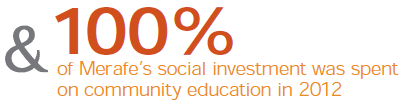
While Merafe has direct relationships with certain key stakeholders in connection with community matters, we also have indirect relationships through our partnership with Xstrata in the Xstrata-Merafe Chrome Venture. As managers of the Venture’s day-to-day operations, Xstrata takes responsibility for engaging with the Venture’s stakeholders. All the Venture’s operations and projects are expected to review the stakeholder engagement plans every year. The Venture’s operations held formal community stakeholder meetings during the year. Details of the Venture’s engagement and Merafe’s engagement during 2012 can be found in the stakeholder engagement tables on our website. The efforts of Merafe and the Venture to address the various material issues we have identified that could impact negatively or positively on our key stakeholders involve national, provincial and local government in their roles as regulators and partners; the trade unions in their role as representatives of the Venture’s employees who are from local communities; and our investors and business partners who are affected by all aspects of our business. The communities in which the Venture operates play a significant part in our ability to do business. They provide the Venture with employees who make an important contribution to its success. Most of these communities live in poor, underdeveloped areas of the country. In their frustration at the lack of jobs, facilities and infrastructure they are turning to the mining industry to address their needs. The growing social activism in these communities can, and has had a negative impact on the Venture’s business. The Venture identifies its impact on host communities, both positive and negative, using social and human rights baseline studies and risk assessments. Both Merafe and the Venture work closely with communities, government and NGOs to gain multiple perspectives of our impacts and possible impacts with the aim of addressing the concerns of, and our impacts on, the most vulnerable people affected by the Venture’s operations. The Venture maintains a register of community complaints at every operation and it deals with complaints at operational level. Anti-mining sentiment The engagement between mining companies and the communities in which they operate is becoming increasingly challenging. Mining communities are turning to the mining industry to address poverty, unemployment and the need for basic infrastructure and services. The Venture’s approach to social and community engagement, as set out in its Sustainable Development Standards, sees consultation with communities as an essential part of its approach to doing business, managing risk and addressing the short-, medium- and long-term sustainability of its business and the communities in which it operates. However, the Venture recognises that this engagement requires an ongoing commitment to building relationships, trust and understanding with the communities. During 2011 the Venture arranged for consultants to carry out baseline studies of the communities in which it operates. The purpose of the studies was to identify the socio-economic needs of these communities and to be clear about their expectations and how best to manage them, develop trust between Xstrata and the communities; and identify the role and responsibilities of the different role players in the area. The studies revealed that in the Limpopo province there are high expectations of what the Venture can do or should be doing for the communities and in many cases these expectations are unrealistic. Trust levels are low between community members and all types of leadership. Because everyone is fending for him or herself in these communities it is very difficult for the Venture to establish agreement on what the communities as a whole need. To begin to address this situation the Venture has embarked on a proactive, ongoing comprehensive communication strategy with the aim of keeping these communities informed of the Venture’s plans in terms of its investment in the communities and what the expected outcomes are. The Venture is also investing in training and education with the aim of strengthening the capacity of local leadership in the area. In the North West province, while communities do not blame the Venture for the lack of progress with regard to basic infrastructure, health services, job opportunities, etc, it is clear that they are at breaking point and as happened during 2012 this type of desperation easily transforms into violent protests. Communities said they are not kept informed of what the Venture is doing for them, what it plans to do, new developments, job and procurement opportunities, etc. The Venture has worked hard during 2012 to improve its communications with communities, which has included regular newspaper advertorials covering its investment in health, education, enterprise development and infrastructure and educational radio programmes. Socio-economic development Both Merafe and the Venture are committed to uplifting communities by investing in their education and skills development. Education • Merafe spent 100% of its social investment on education in 2012, which amounted to R3.3 million As part of its corporate social investment programme Merafe has supported Protec, which provides science, mathematics and technology programmes and materials to schools in the Rustenburg area, since 2010. When members of our board visited two of the nine schools in the programme they were concerned by the lack of suitable infrastructure at the schools. We decided to engage with the schools, identify their needs and involve their governing bodies in sourcing quotes and local service providers to undertake the work required. When we engaged with the schools’ governing bodies we realised that they lacked the knowledge and skills necessary to manage the project. To remedy this we brought in the Adopt a School Foundation, which has a holistic approach to school education improvement and, after identifying the needs of a school, actively seeks funding to implement the necessary reforms by developing the necessary management and community leadership skills that will ensure the quality, credibility and sustainability of our investment. The Venture’s corporate social investment
|
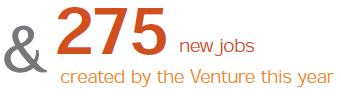
Job creation and skills development • The Venture created 275 new jobs this year The Venture has embarked on a number of skills and enterprise development projects in the communities in which it operates, including learnership programmes, secretarial training, training of students for the Department of Civil Works and portable skills training such as electrical and plumbing training. In addition to the employment created by the Venture’s operations its investment in infrastructure development also creates jobs. While these jobs may only be temporary, the people employed to do them learn portable skills such as bricklaying, welding and carpentry, which equip them better for finding fulltime employment. Procurement • Fifty five percent of the Venture’s discretionary procurement in 2012 was from black-empowered companies (R4.2 billion) Every year the Venture sets itself targets for its discretionary procurement from historically disadvantaged South Africans (HDSAs), which exceed the targets set in the Mining Charter Scorecard. It also aims to purchase as much as possible from local suppliers. Discretionary procurement
Enterprise development
With a national unemployment rate of around 25%, South Africa urgently needs to create employment opportunities. Small, micro and medium enterprises (SMMEs) play a key role in job creation with the Adcorp employment Index indicating that 68% of the 13.8 million people working in South Africa are employed in businesses with less than 50 employees. Enterprise development is an important part of the investment both Merafe and the Venture make in the socio-economic capacity of communities. Both organisations recognise that it is an investment that makes good business sense as developing SMMEs and creating jobs stimulates growth, increases our ability to procure from black-owned enterprises and benefits us all. In addition, the Venture has enterprise development commitments in terms of the Mining Charter Scorecard and any investment in enterprise development also contributes to Merafe’s performance in terms of the broad-based black economic empowerment (B-BBEE) codes. When Merafe commissioned research into suitable enterprise development opportunities in the Rustenburg area during 2012 it highlighted the important role business development support service providers play in increasing the success rate of SMMEs. The research also indicated that business support is most effective when provided to businesses in start-up phase. Merafe selected the Grow your Business programme to work with six SMMEs from the communities in the vicinity of the Boshoek ferrochrome plant and the Horizon mine (these are the assets that Merafe pooled with Xstrata’s assets in 2004). These businesses will be mentored over a 12-month period with the aim of increasing their growth and financial stability and also creating more employment. The six businesses will be selected by means of a rigorous selection process that will include an in-depth assessment of each business. During the 12 months of their mentorship, in addition to weekly visits from their mentor the businesses will have access to an online mentorship tool, which tracks key business indicators including cash flow, number of employees, progress against gaps and areas for development identified at the initial assessment of the business. The Venture supports enterprise development through a number of initiatives. Small businesses often have difficulty obtaining loans from financial institutions because they do not meet their stringent requirements for the granting of credit. The Venture assists companies in this position with start-up and bridging capital and loans with preferential terms. It also offers management expertise in areas such as project management, business planning, cash flow management and legal compliance as well as providing appropriate skills training. The Venture offers community members ABET, computer literacy training and training in portable skills. At the Steelpoort Development Centre in Limpopo province, community education projects run by the Centre include teacher training (in technology education), ABET facilitator training, science teacher training and engineering workshop training for further education and training (FET) lecturers. The Centre not only trains members of the community in skills that will equip them to work in the Venture’s operations but also offers training in marketable skills including bricklaying, welding and household electrical skills. The Centre has expanded its programmes to include a bridging programme that prepares local students for tertiary education. Public health and HIV and AIDS The Venture partners with government, international organisation and NGOs, particularly in the areas of public health, to get the best possible value out of our community investment. The public-private partnerships formed by the Venture provide communities access to prevention, treatment and care for HIV and AIDS, as well as other communicable and associated disease. The Venture supports the government’s HIV counselling and treatment (HCT) campaign by providing funding and testing sites. It has also funded clinics and hospices in the communities in which it operates, including an HIV and AIDS clinic in Lydenburg in Mpumalanga province. There is also a clinic at the Lion ferrochrome plant in Limpopo province. During 2012 the Venture also supported the Tapologo hospice which is a well-designed award-winning 34-bed facility and the only 24-hour hospice facility in the area where it operates in the North West province. The main objective of this hospice, which was previously supported by Merafe, is to provide care for AIDS patients in the terminal phase of the disease and symptom control for patients who need to be stabilised before starting ART. It also offers support to families who are unable to cope with an ill family member and aims to reach people in communities that suffer from general poverty, lack of resources and limited access to essential services, who are infected and affected by HIV and AIDS and other terminal illnesses. Since 2009 the Venture, in partnership with the Regency Foundation, has invested in an HIV and AIDS education and prevention programme for pupils between the ages of 12 and 15, called HIV & Me, reaching over 3 500 learners and 126 educators in a year. Respecting the rights of communities Challenges
|
| Our approach
Both Merafe and Xstrata respect the legislation of South Africa and comply with its human rights legislation, including the Constitution and the Bill of Rights, which safeguard the basic human rights of employees in South Africa. In addition, the policies of both companies clearly state that we do not tolerate any form of discrimination and that all our employees and stakeholders are to be treated with dignity and in a manner that is culturally appropriate, irrespective of gender, background or race. Xstrata supports the United Nations (UN) Universal Declaration of Human Rights and the International Labour Organisation (ILO) Conventions and is a signatory to the UN Global Compact. It has aligned its Sustainable Development Framework, which is applied in all the operations it manages, including the Venture, with its ten universally accepted principles in the areas of human rights, labour, the environment and anti-corruption. Xstrata’s Sustainable Development Standards require the operations it manages to maintain community relations strategies that uphold and promote human rights and respect cultural considerations and heritage. In 2008 Xstrata committed to implementing the Voluntary Principles on Security and Human Rights across all the operations it manages. The Voluntary Principles were drawn up to guide companies in maintaining the safety and security of their operations within an operating framework that ensures respect for human rights and fundamental freedoms. The Principles highlight the role companies can play in promoting respect for human rights and strengthening the rule of law. Xstrata continues to implement the requirements of the Voluntary Principles at all the operations it manages, including the Venture. These requirements encompass human rights risk assessments, relations with public security forces and relations with private security providers. Xstrata reports annually on its progress in upholding the Voluntary Principles.
Xstrata participates in the ICMM Resource Endowment Initiative. The Initiative aims to identify the factors that have allowed some countries to benefit from their substantial resource endowments through economic growth and poverty reduction and to determine practical steps that companies, governments, local communities and aid agencies can take to build capacity to achieve better outcomes from resource development where this is lacking. Resettlement In the course of conducting business the Venture may need to disturb land used by the local community. It always tries to find ways to avoid resettling community members, but when this is the only viable course of action it consults closely with the affected population to develop an equitable solution. It is the Venture’s policy to seek the free, prior, informed consent of communities. Whenever the Venture relocates a community it communicates openly with local community members to inform them of its plans and all their available options. The Venture’s team works with the affected households to find a suitable new area for them to live and work and to ensure that relocation provides them with an equivalent or improved standard of living that is sustainable in the long term, as well as education for the affected households. The Venture works with the community to create economic development and opportunities for quality of life improvement. No resettlements took place in the Venture during 2012. Child and forced labour Xstrata’s Business Principles, which are applied in the Venture, uphold the elimination of all forms of forced or compulsory labour and prohibit any form of child labour. The minimum age for employment in the Xstrata Group is 18, regardless of local legislation. There is no significant risk in respect of incidents of forced or compulsory labour in the Venture’s operations. The age of the youngest person employed by the Venture in 2012 was 18 years of age. Merafe complies with South African labour legislation. Merafe’s youngest employee is 30 years of age. There were no incidents of human rights violations involving indigenous people in the Venture’s operations during 2012. Disputes relating to land use Communities have lodged land claims in respect of properties that are part of the Venture’s current operations. The Venture is currently in discussions with the Regional Land Claims Commission regarding claims by communities over the farms on which the Lion ferrochrome plant is situated. Ethics line A free ethics phone line, which provides a confidential
whistleblowing facility operated independently by
Expolink, is available to the Venture’s employees,
contractors, suppliers, customers, business partners and
community members for the confidential reporting of any
breaches of its Business Principles, Code of Conduct. Our social licence to operate Both Merafe and the Venture seek to deliver longer-term community outcomes that align with our core business objectives through our corporate social investment (CSI) activities. We aim to: • define and track socio-economic and business benefits Merafe’s CSI policy and the Venture’s sustainable development policy and standards describe our expectations for our businesses around community engagement and support. The Venture audits each site’s performance against its sustainable development policy and standards as part of its sustainable development assurance programme. The Venture is an integral part of the communities in which it operates. Both our organisations pay taxes. The Venture provides jobs and skills development opportunities, buys goods and services from local suppliers, supports local infrastructure initiatives and pays royalties to government. Mining acts as a catalyst for social and economic development. The Venture’s operations are often located in areas where there is little, if any industrial activity, government services are lacking and infrastructure needs are largely unmet. Merafe and the Venture have both the opportunity and the responsibility to partner with local communities, understand their needs and foster sustainable growth. We aim to create benefits for the communities in which we operate that will endure after the Venture’s mining activities cease. We need to demonstrate that our presence in a community is beneficial in order to gain access to resources and to obtain a social licence to operate from broader society. We provide economic benefits that are far greater than merely providing jobs and paying taxes. The Venture’s presence in an area stimulates and supports the development of small and medium-sized businesses, which in turn create sustainable jobs and contribute to infrastructure development. |

Finding ways to help micro and very small businesses move beyond the subsistence level to become profitable and self-sustaining is one of the greatest challenges facing enterprise development programmes. R660 000 and a lot of initiative from
community members
Five years ago the Venture, as part of its social and labour plan projects in Limpopo, adopted a group of women who had already taken the initiative to start sewing and selling clothes to make a living. When they started they borrowed the regional chief’s boardroom. Today they have their own premises which the Venture built for them. Initially the Venture bought them domestic sewing machines but as their business expanded these machines weren’t sufficiently robust or fast enough to cope with the volume of orders they had. Now they have nine industrial machines, a buttonholer and a machine that embroiders and they have been given training in how to operate these very complex machines. When we visited the project we saw piles of school uniforms, anoraks with beautifully embroidered school crests, overalls, traditional dresses and security vests all ready to be despatched to their customers. The Venture is delighted that its investment has allowed these enterprising women to develop a sustainable business through their own initiative. They didn’t wait for others to help them, instead they went out and found customers and asked for financial assistance from us. Because they ensure that the work they deliver to their customers is always of a high standard, they generate repeat orders. The Venture’s Limpopo operations have arranged for their suppliers to commission the project to manufacture their safety jackets. These suppliers have also shared their expertise in setting up a factory-style production line and purchasing fabric at more economical prices with the project team and have given them additional training on their new equipment. The Venture also introduced the project team to Sage Wise, specialists in capacity building in small businesses, who are training them in business management and advising them on how to comply with statutory requirements.
|


| ICONS USED IN THIS REPORT | DOWNLOADS | |||||||
 |
|