 |
 |
 |
|

 Letter to stakeholders
| Currently viewing: Climate change and energy / Next: Environment |
|


CLIMATE CHANGE AND ENERGY
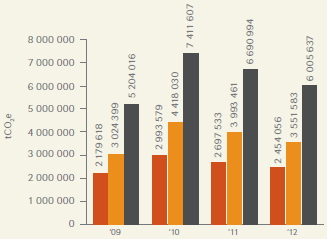
The returns earned by Merafe’s investors can be negatively affected by pricing, carbon taxes, non-availability of a supply of electricity and the prices customers have to pay for the Venture’s products. The Venture’s stakeholders benefit from its energy efficiencies which have made it one of the lowest-cost ferrochrome producers in the world and the lowest-cost producer in South Africa. The Venture is a major purchaser of electricity from Eskom and any energy efficiencies it achieves reduce pressure on Eskom, which is currently struggling to meet electricity demands. The government is responsible through the Department of Energy (DoE) for South Africa’s energy production strategy, the National Treasury for a proposed carbon tax and the Department of Environmental Affairs (DEA) for climate change policies. Government’s actions and decisions can have a positive or negative impact on our business. The price and availability of power can threaten the viability of the Venture’s ferrochrome business in particular. Engagement with stakeholders We keep our investors and business partners informed on climate change and energy issues. This engagement includes regular board and committee meetings and reporting. The Venture, which engages regularly with government, was instrumental in establishing two important and influential structures in South Africa: the Energy Intensive User Group (EIUG) and the Industry Task Team on Climate Change (ITTCC) which are both well-regarded and respected by government and big business. The Venture mainly engages with government through these structures and as a member of the South African ferrochrome industry. During 2012 the Venture focused on the pricing and security of power in South Africa, the proposed carbon tax and climate change policies. The Venture is also assisting with the development of the DoE’s integrated resource plan. Merafe’s emissions Merafe established its carbon footprint for the first time in 2012, which was 86 tCO2e. In order to offset its carbon footprint Merafe is purchasing trees from Food and Trees for Africa and has requested that these trees are planted in a disadvantaged community in the vicinity of the Venture’s operations. The Venture’s emissions The Venture measures its GHG emissions as carbon dioxide equivalent tonnes (tCO2e). The Venture’s total Scope 1 (direct) and Scope 2 (indirect) GHG emissions during 2011 amounted to 6.7 million tCO2e and this reduced to 6.0 million tCO2e in 2012. During 2012 the Venture carried out an annual review of its climate change strategy, targets and plans and its energy improvement plans. It also identified energy reduction projects on which to perform feasibility studies. The availability of funding and uncertainty regarding the increase in power costs made this a difficult exercise. A significant amount of work was done on a waste heat recovery project at the Wonderkop ferrochrome plant. Waste heat will be harvested using the Organic Rankin Cycle process to generate electricity. This project will be funded by an independent power producer from whom we will buy back the electricity produced. The feasibility of this project, however, depends on market conditions and future electricity prices.
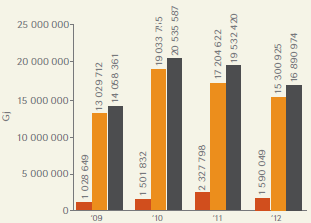
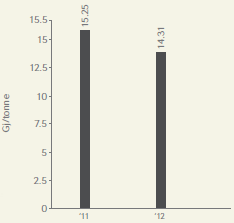
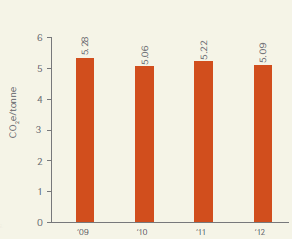
The Rustenburg ferrochrome plant is also exploring the possibility of a waste heat recovery project, but the plant has not yet decided on the technology it will use; and is also looking at the possibility of capturing gas from the municipal waste dump, which can then be used as an energy source by the plant. The Venture hopes to sign a memorandum of understanding with the Rustenburg municipality in the near future, which will allow the plant to conduct a feasibility study. The Venture’s energy consumption Total energy consumption in the Venture’s operations decreased 14% year-on-year, partially as a result of lower production volumes and partially as a result of increased energy efficiency. The Venture’s approach to climate change and managing carbon emissions The Venture has worked for many years on climate change-related initiatives. It has improved its energy efficiency throughout its business and invested in technological solutions that have made its ferrochrome operations the most energy-efficient in the world. It constantly looks for ways to further reduce its energy use per tonne of product and is researching safe solutions to capturing, storing and using carbon dioxide (CO2) emissions from its ferrochrome smelting operations to produce energy. Xstrata and the Venture apply a global factor based on the GHG protocol (0.8349 kg CO2/kWh) when measuring the Venture’s greenhouse gas emissions. The Venture’s investment in the Bokamoso and Tswelopele pelletising and sintering plants and the Lion ferrochrome plant Phases I and II are all aimed at reducing its consumption of electricity and consequently its carbon footprint. The Venture includes carbon and climate change risks in its business risk management systems and continues to improve its standards and protocols to measure and monitor and report on its carbon footprint. The Venture’s climate change strategy The Venture’s existing climate change strategy consists of three elements, which are to:
Xstrata began a review of its global climate change strategy, which is applied in the Venture, late in 2011. The objectives of this review were to:
The risks associated with climate change Climate change remains a key longer-term risk for the Venture. The potential risks it faces from climate change are both physical and financial. They are complex risks as they include operational risks such as business continuity, health and safety, environmental aspects and regulatory aspects. The Venture needs to constantly engage with legislators, researchers and industry bodies, track and evaluate the situation and develop an improved awareness of and preparedness for the risks associated with climate change. It works with members of its industry and other stakeholders to understand the potential impacts of climate change and take action to minimise them where climate change is likely to have the most effect and where the Venture can make the greatest difference. Possible physical and financial impacts The Venture’s operations could be damaged by flooding and extreme storms which could cause business interruptions. The reduced availability of water could also interrupt its business and could have health impacts. Some of the Venture’s operations are located in arid areas where prolonged drought conditions could limit production growth or prevent it from operating. The risks associated with pricing and security of electricity supply Higher energy costs negatively affect the Venture’s ability to contain operating costs and remain competitive, especially in its ferrochrome operations which are major consumers of electricity. One of the risks associated with the introduction of a carbon tax in South Africa is the impact it would have on the cost of our electricity (produced by burning fossil fuel which produces GHGs) and transportation. It would also increase operational costs related to GHG emissions monitoring, reporting and accounting. Engaging in public policy The Venture is assisting the DoE with a carbon budgeting process which involves developing a scientific process for estimating what the country’s annual carbon emissions are likely to be, understanding what reduction it is possible for the country to achieve and developing a model that will allow the DoE to put a reasonably accurate price on carbon emissions. Our participation in discussions and interventions with government is through the EIUG and ITTCC. Understanding the Venture’s carbon footprint The Venture generates GHG emissions from its smelting processes and from its energy use. The use of fossil fuels in the form of diesel and petrol in vehicles contributes directly to the creation of GHGs and the electricity supplied from coal-fired power stations contributes indirectly to the creation of GHGs. The Venture and Merafe are committed to minimising GHG emissions and improving our energy efficiency, and recognise the magnitude and importance of this challenge. |
||||||||||||||||||||||||||||||||||||||||||||||


| ICONS USED IN THIS REPORT | DOWNLOADS | |||||||
 |
|