 |
 |
 |
|

 Letter to stakeholders
| Currently viewing: Manufactured capital / Next: Natural capital |
|


MANUFACTURED CAPITAL
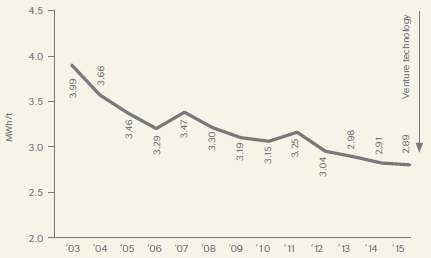
Stakeholder impact The stakeholders affected by our operations and who can affect our operations include the employees and contractors who work in our operations and our suppliers whose livelihood depends on the success of our operations. Our shareholders rely on the profitability of the Venture’s operations and the government is responsible for monitoring the compliance levels of our operations. Operating performance The Venture produced a total of 1 180 000 tonnes of ferrochrome in 2012, which is 8% less than its production in 2011, using only 66% of its operating capacity. The weak market conditions influenced its decision to participate in Eskom’s power buy-back programme and sacrifice approximately 130 000 tonnes of production. To avoid incurring high winter electricity tariffs the Venture also took the decision to produce at only 40% of its capacity during the winter months of 2012. The Venture’s decisions to take furnaces out of production are influenced by a number of issues. These include the need for furnace refurbishment, a particular furnace being either less efficient or more expensive to run than other furnaces or the need to spread production between plants to keep workforces busy. When the Venture agreed to participate in Eskom’s power buyback programme it first made sure it could meet its contractual obligations, maintain its reputation as a reliable supplier of ferrochrome, that no employee would lose a job as a result of the buy-back programme and that the programme would be financially beneficial to the Venture. To be successful the Venture needs Eskom to provide it with a reliable, fairly-priced supply of electricity. It is for this reason that it cooperates with Eskom and whenever possible, participates in programmes that help Eskom meet its commitments. By the end of 2012, 18 of the Venture’s 20 furnaces were back in operation and in spite of the labour unrest that affected the South African mining industry during the year, the Venture lost very little smelter production to strike action. As a precautionary measure the Venture postponed starting up furnaces which had been refurbished during the winter months. Industrial action at the Venture’s mines had a significant impact on ore production volumes, but because its furnace operations were reduced, stockpiled ore was sufficient to meet its requirements. The Venture’s vulnerability to industrial action was reduced because while its operations in one region were affected, those in other regions where a different trade union is in the majority were not. The Venture managed to restrict its total cost increases to 9.2% yearon-year despite costs being driven up by the electricity tariff increase of 16.7%. Despite these circumstances the Venture’s ongoing cost saving exercises and investment in consumption efficiency improvements have helped it achieve ongoing yearon-year real cost decreases over the past eight years. The Venture’s cost saving efforts include using more of the lower-priced UG2 ore in its ore mix; optimising its reductant mix and reducing fixed costs. The Venture’s use of its inhouse patented Premus technology at the Lion and Lydenburg ferrochrome plants and Outotec pelletising technology at its Motswedi, Bokamoso and Tswelopele plants continued to improve its energy efficiencies. Our operations
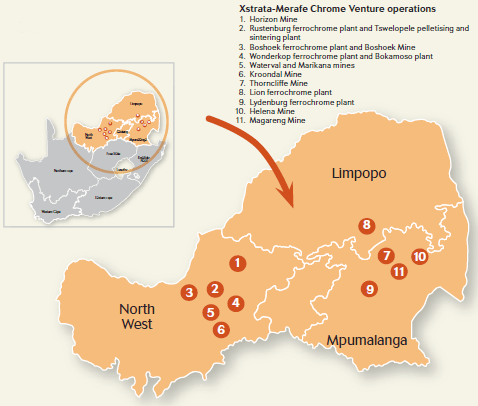
Xstrata-Merafe Chrome Venture’s operations
The Venture has access to various UG2 plants, in the Western Limb including Eland, EPL, Kanana, Kl, K2, K4 and Rowland, and Mototolo in the Eastern Limb. Projects During the year the Tswelopele pelletising and sintering plant was completed on schedule and within budget with the R900 million plant being hot commissioned on 7 October and reaching its designed production capacity within two months of operation. In addition, we congratulate the project team on its outstanding safety record with over 1.6 million man hours being worked on the project without any lost time injuries. The project’s approach to safety was to keep it simple. It used a one page document to summarise the high risk activities facing a team on a particular day and to explain to the team how to perform these activities safely. Supervision levels were improved by not allowing more than 15 team members to work without a supervisor. Management practised ongoing visible felt leadership and there was zero tolerance for any deviation from the project’s 20 cardinal rules. Good behaviour was recognised. Other outstanding performances on the Tswelopele project were the achievement of optimum audit results on both internal and external audits for all aspects of project management. The capacity of this plant is 600 000 tonnes of pellets per annum. Since it went into production the ore and electricity consumption efficiencies of the Rustenburg plant have improved by more than 21% and 11% respectively. Other advantages are that the plant will produce less slag, emit fewer fugitive emissions and use less water and less diesel by reducing transport requirements. The plant also enables the use of more UG2 ore that cannot be used without being agglomerated. Energy efficiency improvements
Good progress was made at Lion Phase II, a 360 ktpa ferrochrome smelter that is being constructed at a capital cost of R4.9 billion. Heavy rainfall and community unrest influenced progress on the civil work during the first few months of 2012. This smelter, based on the energy efficient Premus technology, will be commissioned towards the end of 2013. Once the plant is fully operational additional consumption efficiency improvements and cost savings will be achieved. Developments at the Horizon Mine progressed well and ramp-up to full production capacity will start during the first half of 2013. Development of the Magareng mine is complete and the mine’s beneficiation plant will also be commissioned during the first half of 2013. Product stewardship The Venture monitors and addresses the impacts and risks associated with the use of its products throughout their life cycles, including during stages outside of its control, such as use, recovery, recycling and disposal. It works with national and international industry associations, its customers and suppliers to understand the environmental health and safety risks of its products and to find ways to mitigate these risks. In terms of Registration, Evaluation and Authorisation and Restriction of Chemicals (REACH), all the products the Venture exports to countries in the European Union have been pre-registered, with the relevant preregistration certificates and numbers available. The Venture is also actively involved in REACH. No products produced by the Venture, or their packaging materials, were reclaimed during 2012. The Venture is participating in a life cycle inventory project for primary ferrochrome production. The scope of the project is to create a life cycle inventory for one kilogram of chromium contained in ferrochrome. The project includes the mining of chrome ore and transportation to the smelters, the transport of reductants and fluxes to the smelters and the smelting and production of ferrochrome up to the gate of the smelters. It will also include a complete assessment of downstream ferrochrome uses (for example in the stainless steel industry). The Venture is collaborating with other South African producers on this project. To ensure the quality of its products the Venture aligns its systems with the requirements of ISO 9001:2008 and some of its smelters are certified. Its laboratories are ISO 17025 accredited, which ensures that the methods and equipment it uses are accurate. Tswelopele facts
|
||||||||||||||||||||||||||||||||||||||||||||||||||||||||||||||||||||||||||||||||||||||||||||||||||||||||||||||||||||||||||||||||||||||||||

| ICONS USED IN THIS REPORT | DOWNLOADS | |||||||
 |
|