
Remuneration report
This remuneration report is in accordance with King IV requirements. A glossary of terms used in this report is contained in our online Integrated Annual Report of 2018 which is on our website. If unable to access the online report please note the following key references used: “Policy" means the Remuneration Policy of the Company; the “Company” or “Merafe” means Merafe Resources Limited and its subsidiaries; the “Committee” means the Remuneration and Nomination Committee of the Company; the "Board” means the Board of directors of the Company; "executive directors and non-executive directors” means executive and/or non-executive directors of the Company; the "CEO" means the Chief Executive Officer of the Company; and "FD" means the Financial Director of the Company.
Statement of voting at Annual General Meeting
The AGM of the Company was held on 8 May 2018 and the requisite ordinary resolutions of a non-binding advisory nature endorsing the Policy and the remuneration implementation report were passed. The Policy resolution (resolution 6.1) was passed by a 74% majority, with 83.70% of the Company’s shares being voted. The implementation report resolution (resolution 6.2) was passed by a 87.88% majority, with 83.68% of the Company shares being voted.
Subsequently, in 2018, the Company invited shareholders to engage on the Remuneration Report and the Company engaged with shareholders who responded. Changes were implemented in respect of its remuneration approach and Policy in order to respond ro shareholder concerns and align more fully to King IV and market practices. The Company commits to engage further with shareholders in respect of its Policy and approach should the need arise after the 2019 AGM.
Background statement
Remuneration philosophy, strategy and policy
Remuneration philosophy
The Company’s guiding philosophy is to employ high-calibre, highperforming employees who subscribe to the values and culture of our Company. We recognise that our employees are integral to the achievement of our corporate objectives and they are accordingly remunerated for their contribution and the value they deliver.
Our Company is committed to fair, responsible and transparent remuneration across the business in respect of all employees on all levels. Both the fixed and variable elements of remuneration aim to support Company performance and value creation in the short, medium and long term, as well as to support the achievement of strategic objectives within the Company’s risk appetite.
This policy is applicable to all employees of the Company.
Our remuneration strategy and policy are regularly reviewed by the Committee to ensure that they are appropriate and relevant in the support of sustainable business performance and in promoting an ethical culture and responsible corporate citizenship.
Remuneration strategy
Our remuneration strategy is designed to be aligned with our business strategy and the execution thereof to promote positive outcomes. Since we strive to attract, retain, motivate and reward employees for executing our business strategy, their remuneration must clearly be market-related and independent third parties are used by our Committee for the purpose of benchmarking to the appropriate segment. The general principle of our remuneration strategy is to structure executive and employee remuneration to include:
- a guaranteed annual package and benefits;
- an annual variable performance bonus; and
- ownership of shares through the long-term incentive scheme which is based on performance with the aim of creating a strong alignment to shareholder goals.
The remuneration strategy and policy are communicated to all employees during the year, together with our expectations around their contribution to the success of our organisation.
Remuneration policy
The key principles of the remuneration policy are that:
- the policies are governed by the Committee which regularly reviews them to ensure that they are relevant and support Company strategy;
- guaranteed remuneration is targeted at the median to lower quartile of the relevant market against which pay is benchmarked, in order to attract and retain high-calibre and high performing employees;
- it is Company policy that all employees are members of medical and retirement funds and have Group life and disability cover;
- annual salary adjustments are governed by factors such as the consumer price index (CPI), retention strategies, the producer price index (PPI), industry performance, projected growth, contractual arrangements, affordability, and industry average increase surveys, which will be taken into consideration in setting the recommended increase. The Committee will approve or set the overall increase percentage that will be applied on a Company wide basis. Salary adjustments are at the discretion of the Board;
- variable pay is an important component of remuneration at Merafe and both annual and long term performance-based schemes which support our business strategy are in place;
- the short-term incentive scheme performance measures are assessed by the Committee and these measures are determined by taking into account corporate, individual, financial and non-financial criteria. The measures are applicable to the time period to which the scheme relates;
- the long-term incentive scheme measures are based on total shareholder return and a financial measure, appropriately weighted, as determined by the Committee from time to time, aligned to business requirements;
- executive remuneration is aligned to shareholder value creation through the long-term incentive scheme;
- where necessary, both short-term and long-term incentive schemes are benchmarked against the appropriate database by the Committee; and
- the over-riding principle governing payments for non-executive directors is that they will be made in the context of good governance and aligned to the relevant market.
Remuneration and Nomination Committee
Responsibility for the reward strategy rests with the Company’s Board of Directors (“Board”) who in turn appoint the Committee. The Committee comprises at least three members, the majority of whom are independent non-executive directors and is governed by formal Terms of Reference.
The Terms of Reference inter alia clearly deal with matters such as (1) composition of the Committee; (2) roles and responsibilities; (3) delegated authority; (4) tenure and rotation of the Committee members; (5) reporting requirement and compliance; (6) access to information and resources; (7) meeting procedures to be followed; and (8) arrangements for the evaluation of the Committee's performance.
The primary role of the Committee is to ensure that the Company’s directors and senior executives are fairly rewarded for their individual contributions to the Company’s overall performance. The Committee also aims to ensure that remuneration is appropriate to attract, retain and motivate the right calibre of directors and senior executives, who will strive to achieve the overall goals of the Company. The Committee must demonstrate to all stakeholders that the remuneration of senior executives is set by a committee of Board members who:
- have no personal interest in the outcome of their decisions;
- give due regard to the interest of the shareholders and the financial and commercial health of the Company;
- take cognizance of market related remuneration, incentive bonuses and share incentive schemes as well as market trends; and
- play an active role in succession planning activities, notably for the Chief Executive Officer and executive management.
The Committee is responsible for making recommendations to the Board on remuneration policy for directors and, to the extent it deems necessary, makes comparisons between remuneration packages currently available to the Company’s own executive directors and those available to directors of other companies of a similar size in the comparable industry. Comparisons are also made with other companies in South Africa and, if relevant, internationally.
 See our online Integrated Annual Report for 2018, under remuneration report for
our Remuneration Policy which is also attached as Appendix 2 to this report.
The Committee also takes into account a number of principles, being inter alia:
- industry standards and comparisons with businesses in the same industry;
- expertise and qualifications of individuals;
- the risks associated with companies in the mining sector;
- the importance of the individual to the Company and his/her contribution;
- retention measures and motivation for the executive not to leave the Company;
- restraint of trade provisions; and
- nature of the position (role expectations, work load, etc.).
Remuneration policy
Statement of fair, responsible and transparent remuneration
The Board approves a policy that articulates and gives effect to its direction on fair, responsible and transparent remuneration.
The Policy for the remuneration of executive directors and other senior management is set taking appropriate account of remuneration and employment conditions of the industry, the Venture and the Company’s specific circumstances.
Key principles
The Policy is governed by the Committee which regularly reviews the Policy to ensure that it is relevant and supports the Company strategy. To this end, guaranteed remuneration is targeted at the median to lower quartile of the relevant market data (against which we benchmark) to retain and attract high-calibre and high-performing executive directors and employees.
The Policy dictates that all full time employees are members of medical and retirement funds and have Group life and disability cover.
Variable pay is an important component of the Policy and both annual and long-term performance-based schemes which support our business strategy are in place.
The short-term incentive scheme performance measures are assessed by the Committee and these measures are determined by taking into account corporate, individual, financial and non-financial criteria. The measures are applicable to the time period to which the scheme relates.
The long-term incentive scheme measures are based on Total Shareholder Return (TSR) and growth in headline earnings per share.
Executive director remuneration is aligned to shareholder value creation through the long-term scheme.
Where necessary, both short-term and long-term incentive schemes are benchmarked against the appropriate databases by the Committee.
Annual salary adjustments are governed by factors such as the consumer price index ("CPI"), retention strategies, the producer price index ("PPI"), industry performance, projected growth, contractual arrangements and affordability, and industry average increase surveys, which are taken into consideration in setting the recommended increase. The Committee will approve or set the overall increase percentage that will be applied on a Company-wide basis. Salary adjustments are at the discretion of the Board.
| Target reward mix for Chief Executive Officer | |
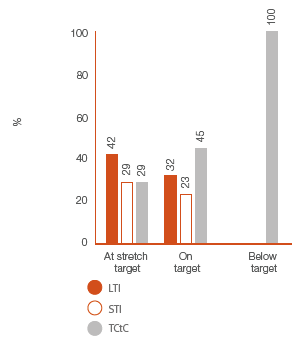 |
|
| Target reward mix for Financial Director | |
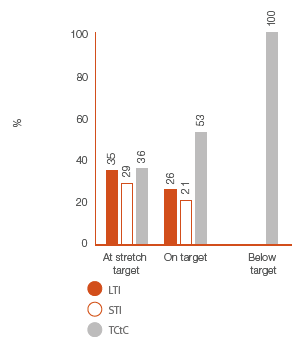 |
Executive pay mix
Executive pay mix is defined as the balance targeted between the major components of executive remuneration, namely:
- Guaranteed pay – based on Total Guaranteed Cost of Employment (“TCtC”)
- Variable pay for perfor
- Short term incentives in the form of annual cash incentives (“STI”); and
- The expected value from long term incentives (“LTI”).
Note: Expected value is defined as the present value of the future reward outcome of an offer, given the targeted future performance of the Company and of its share price. It should not be confused with the term “fair value” which is used when establishing the accounting cost for reflection in a Company’s financial statements. Neither should it be confused with the term “face value” which is used to define the current value of the underlying share at the time of an offer.
The Company’s targeted pay mix aims to align the incentives of employees with the interests of shareholders. It is recognised that through acquisitions and business combinations over time, there will always be some deviation from the targeted pay mix structure across the Company. However the balance between TCtC, STI and LTI for executive directors are shown for illustrative purposes in the schematic below, at various performance levels.
Guaranteed pay
Merafe aims to establish and maintain an integrated pay line with pay levels that ensure that it is able to remain competitive, while managing costs.
Executive remuneration in respect of guaranteed pay is expressed in terms of TCtC.
An employee’s TCtC consists of the following elements:
- Basic salary;
- Car and other cash allowances and/or perquisites;
- Employer contributions to the medical aid;
- Employer contributions to the retirement funding; and
- Employer contributions to risk benefits.
Salaries are reviewed annually and are targeted at the median to lower quartile of the relevant market. The Company conducts benchmarking exercises at least every second year against the top management reward surveys conducted by the large consultancies. The benchmark used is the median to lower quartile total guaranteed cost of employment for similar positions in similarly sized listed companies.
The Committee has regard principally to companies in the RSA market which are of similar size, complexity and scope to the Company. The Committee also takes into account business performance, salary practices prevailing for other employees in the Company and, when setting individual salaries, the individual’s performance and experience in the role.
Although salaries are reviewed annually, the Board reserves the right not to grant increases should circumstances so dictate. In addition, benefits offered are also reviewed on an annual basis to ensure that employees’ needs are addressed fairly, schemes are cost effective, well governed and competitive.
Short term incentives
Merafe’s annual incentives are aimed at rewarding a combination of both business and individual performance in order to support a Company-wide performance culture. The bonus pool is determined as a percentage of Net Profit after Tax and the scheme is therefore self-funding. Financial and non-financial criteria as well as individual performance determine the bonus pool’s distribution to individuals. Incentive awards are at the discretion of the Board after due consideration of Company and individual performance.
The Committee follows a less mechanistic approach in determining the bonus awards in order to reward outstanding performance more appropriately and to ensure that undue windfalls are mediated. As indicated above, the incentive scheme performance measures are assessed by the Committee and these measures are determined by taking into account the Company’s financial and non-financial criteria as well as individual performance.
All STI awards are based on performance against inter alia, the following measures:
- Company measures: These include but are not limited to profitability, growth of business, cost management, sustainability and safety; and
- Individual measures: For the Chief Executive Officer and Financial Director, these include but are not limited to stakeholder engagement, talent management, leadership and reporting.
Targets are set by the Board on an annual basis as determined by Company strategy, business plan and operating conditions. Targets are set to ensure that performance is measured appropriately in accordance with a five-point rating scale. In addition, the Board will apply appropriate weights to measures in order to focus behaviour and performance, related to the strategic focus for the performance period.
Although measures and targets are determined at the start of the performance period, the Board may revise these measures and targets should prevailing business conditions indicate this to be necessary or in response to any other changes in the operating environment. All such changes, which represent the discretionary aspect of the policy, will be disclosed on an annual basis.
As indicated above, individual performance is primarily assessed from a predetermined criteria of key performance areas or value drivers. The selection of these is informed by the Company’s business plan.
These metrics are assessed against a five point scale as follows:
| Rating | Description | Definition |
|---|---|---|
| 1 | Poor | Indicates poor performance. All or most threshold targets not met. |
| 2 | Needs improvement | Performance against target is fair, however, performance against key measures is below threshold or target. |
| 3 | Satisfactory | Performance on target in respect of most or all measures. |
| 4 | Good | Performance exceeds target on most or all measures. Have reached stretched target on a number of key measures. |
| 5 | Outstanding/excellent | Significant outperformance. All stretched targets met or exceeded. |
The total STI pool available is capped at 3% of Net Profit after Tax. No bonuses are payable where the Net Profit after Tax in any financial year is less than R125 million. These parameters are revised by the Board on an annual basis for relevance and appropriateness.
In addition, the percentage for STI is capped for the various categories of employees as set out below:
| Position | Maximum % of TCtC |
|
| Chief Executive Officer | 100 | |
| Financial Director | 80 | |
| Senior management | 60 | |
| Management | 50 | |
| Administrative staff | 30 |
The total pool for incentives that become available for distribution will not be exceeded at any time.
STI potential is benchmarked between the median and 75th percentile of the relevant market, which is deemed appropriate when considered along with the guaranteed pay benchmarked at between the median and 25th percentile of the market.
The final incentive calculation is undertaken by aggregating the bonus claims of all participants and comparing this with the bonus pool derived from Company performance.
Long term incentives
Background
The purpose of the share incentive scheme is to serve as an incentive and reward to employees of the Company and its subsidiaries for services rendered and to be rendered, aimed at promoting the continued growth of the Company by giving employees an opportunity to acquire shares in the Company and serve as a retention mechanism for employees whose services are regarded by the Company to be crucial to the future growth and sustainability of the Company’s business.
The share incentive scheme further seeks to align employee interests with those of shareholders and to support a culture of ownership, with a focus on Company performance and sustainable growth.
Long term incentives, in the form of a share incentive scheme, have been in existence in the Company since 1999. The current share scheme was approved on 13 April 2010, under which both share options and share grants may be issued.
Eligibility and participation
All employees of the Company are eligible for share allocations in respect of the share incentive scheme rules, subject to Board approval and the prevailing implementation policy.
Shares to be allocated
Under the rules of the share incentive plan, the following shares may be offered:
- Share options which will be granted at the offer price
- Share grants being full value shares.
Vesting rules and settlement
Generally share options vest one third per year on the 3rd, 4th and 5th anniversaries and are settled by physical delivery of shares against receipt of payment of the option price. The options lapse after seven (7) years if not exercised, while employed within the Group.
Share grants are granted by the Board on the recommendation of the Committee. They vest one third per year on the 3rd, 4th and 5th anniversaries and are settled by physical delivery of shares. Alternatively, the Company has the right to settle in cash the value of shares granted.
Equity settlement will take the form of repurchasing of shares on the open market for the benefit of the employee whose shares have vested. The Company reserves the right to issue new shares for purposes of settlement.
Participation and termination rules
In the event of an employee leaving the Group for a reason approved by the directors, such as retirement or disability, all shares granted will vest. All approved terminations will be disclosed on an annual basis.
In the event of either a no fault termination or an employee's death, shares granted will vest within three months. In addition, in the event of retirement at the earliest date allowed by the retirement fund, all share grants shall vest.
In the event of either a no fault termination or an employee’s death, the employee or his/her estate has 12 and 24 months respectively to exercise share options granted to that employee. In the event of retirement at the earliest date allowed by the retirement fund, the employee will have one year to exercise their share options allocated.
In the event of voluntary termination (i.e resignation) or a fault termination, (i.e. those that leave as a result of resignation, dismissal or poor performance), any right to any shares and all allocations will lapse immediately upon termination. No further claims may be laid to such lapsed shares, whether full value or shares options.
In the event of a change in contract of employment, e.g. lateral moves or promotions, the participant will remain entitled to previous share allocations, subject to vesting periods, vesting schedules and prevailing performance conditions and criteria as set out during the initial share allocation.
In the event of a reconstruction or takeover, share allocations will vest on a pro-rata basis subject to the Committee evaluating the applicable performance conditions and determining the number of shares per participant.
Performance vs retention shares
During 2013 a decision was made by the Committee to vary the balance between performance and retention oriented grants or options and also to simplify the performance criteria that determine vesting of the performance grants.
The balance between performance oriented share grants and the retention oriented share grants for the CEO was weighted 70% in favour of the performance oriented share grants.
For executive directors and senior managers these percentages were (respectively) 60% and 50%. All other participants received only retention oriented share grants.
In response to shareholder requirements for more share grants to be subject to performance conditions as opposed to retention shares, the allocation policy was revised in 2018 as follows:
Revised LTI allocation policy
| Merafe LTI offer policy current | ||||||
| LTI (expected value) % of TCtC |
Targeted offer value % of TCtC |
Balance performance/ retention |
||||
| Chief Executive Officer | 70 | 50 | 70/30 | |||
| Financial Director | 50 | 35 | 60/40 | |||
| Senior management | 40 | 30 | 50/50 | |||
| Management | 30 | 25 | 0/100 | |||
| Administration | 20 | 15 | 0/100 | |||
| Merafe LTI offer policy proposed | ||||||
| LTI (expected value) % of TCtC |
Targeted offer value % of TCtC |
Balance performance/ retention |
||||
| Chief Executive Officer | 70 | 60 | 100/0 | |||
| Financial Director | 50 | 45 | 100/0 | |||
| Senior management | 40 | 40 | 100/0 | |||
| Management | 30 | 35 | 100/0 | |||
| Administration | 20 | 25 | 100/0 | |||
All future share allocations will be performance based. In order to balance back to the reward mix and expected outcomes, the targeted value of the share allocation as a percentage of TCtC was increased as per the table above.
Performance criteria
The performance criteria for all existing performance oriented share grants will remain in place, but future grants will be governed by two metrics: (1) Comparison of Merafe’s TSR over a three year period with that of a selection of JSE listed, small cap mining and resources companies, and (2) Growth in Headline Earnings per share (CPI + a specified percentage as determined by the Board) over a three year period. The two measures will weigh 50/50 or as determined by the Board from time to time. Measures will be applied per performance share allocation and will remain in force for the duration of the performance period. Performance measures and targets are approved for and applicable to a specific performance period. No retesting of performance conditions is allowed.
The Committee will assess performance against target once the applicable performance period is completed and approve the vesting of performance shares to the extent that targets are met.
Performance measure I: Total Shareholder Return
The comparator Group for Total Shareholder Return (“TSR”) is made up as follows:
TSR Comparator Group
| Company | Ticker | |
|---|---|---|
| Royal Bafokeng Platinum Ltd | RBP | |
| Harmony Gold Mining Ltd | HAR | |
| Lonmin plc | LON | |
| Hulamin | HLM | |
| Pan African Resources plc | PAN | |
| Merafe Resources Ltd | MRF | |
| Tharisa plc | THA | |
| MC Mining Ltd | MCZ | |
| DRDGOLD Ltd | DRD | |
| Eastern Platinum Ltd | EPS | |
| Wesizwe Platinum Ltd | WEZ | |
| ArcelorMittal Ltd | ACL |
Assuming that a Group of 12 (11 + Merafe) companies are adopted as the comparator Group of companies, vesting of the performance based share grants will be in accordance with the following policy:
- 50% of performance shares allocated will be subject to performance against the TSR measure;
- If Merafe’s TSR over the three year period places it in one of the top four positions, then the full number of performance granted shares subject to this measure will vest in equal proportions on the 3rd, 4th, and 5th anniversaries of their grant;
- If Merafe’s performance over the three year period places it in 5th position, then two thirds of the number of performance granted shares will vest in equal proportions on the 3rd, 4th, and 5th anniversaries of their grant;
- If Merafe’s TSR over the three year period places it in 6th position, then one third of the number of performance granted shares will vest in equal proportions on the 3rd, 4th, and 5th anniversaries of their grant; and
- If Merafe’s TSR over the three year period places it below 6th position, then none of the performance shares will vest.
The table below provides details of the revised vesting schedule for performance shares subject to the TSR measure:
Revised vesting schedule TSR
Vesting schedule over three years – Total Shareholder Return
| Merafe TSR position/ranking relative to peers | Vesting quantity % of allocation* Current |
Vesting quantity % of allocation* Proposed |
||
| Position 1 – 4 | 100% | 100% | ||
| Position 5 | 66.6% | 66.6% | ||
| Position 6 | 33.3% | 33.3% | ||
| Position 7 – 10 | Linear vesting 0% to 33% |
0% | ||
| Position lower than 10 | 0% | 0% |
* Vesting over three years in equal portion.
Performance measure II: Growth in Headline Earnings per share (HEPS)
Assuming that the performance targets below are set by the Board as illustrated in the table below, vesting of the performance based share grants will be in accordance with the following policy:
- 50% of performance shares allocated will be subject to performance against the growth in HEPS measure;
- If performance meets or exceeds target, i.e. CPI + 2% over the performance period, 100% of shares will vest;
- If performance is at threshold, i.e. CPI + 1% over the performance period, 50% of shares subject to this measure will vest;
- For performance below threshold, 0% of shares subject to this measure, will vest; and
- Linear vesting will take place between different performance milestones.
Vesting schedule for Growth in HEPS measure
Vesting schedule over three years – Growth in HEPS
| HEPS target | Vesting quantity % of allocation* Proposed |
|
| On target CPI + 2% | 100% | |
| Threshold CPI + 1% | 50% | |
| Below threshold | 0% |
* Vesting over three years in equal portion.
LTI offer policy
The following principles will govern the LTI offer policy:
- Share options will only be given at the discretion of the Board as and when circumstances dictate and only to executive management that have direct line of sight in terms of Company performance;
- Full value shares, with performance conditions, will be granted to all employees on an annual basis subject to ongoing satisfactory individual performance, the expected value of which will be in accordance with the Company’s reward strategy – pay mix;
- Full value shares may be offered to new appointees as an attraction measure, the value of which will be determined and approved by the Committee, and will be subject to a minimum of three years vesting period;
- Share grants will be in favour of performance based shares, with all shares granted subject to performance measures over a three year period;
- Share grants will be offered to employees with only performance and no retention shares;
- The value of the share grant will be calculated as a percentage of the current TCtC guaranteed package;
- No offer shall be made which together with any other scheme shares would exceed 5% of total issued share capital of the Company;
- The maximum aggregate number of shares granted or options allocated to a single participant, shall be limited to 1% of the total issued share capital of the Company;
- Prior to vesting, no participant will qualify to receive any dividends declared;
- The Company will communicate to participants, at least on an annual basis, in terms of shares granted, vesting and/or any changes in rules or conditions of participation; and
- All share grants and options will be disclosed over its lifetime in the annual Remuneration Report.
Contracts of employment
Senior and executive management are subject to the Company’s standard terms and conditions of employment where notice periods are between three and six months. In line with the recommendations set out in the King reports, Company policy prevents any senior or executive manager from being compensated for loss of office.
None of the senior or executive management have extended employment contracts or special termination benefits or balloon payments.
In the event of a change of control of the Company (as defined in the Companies Act) where the Company no longer requires an executive to fulfil their specific role post the change of control, the Company shall pay to the executive 12 months remuneration on the last day of the notice period and after completion of handover of duties.
Retention measures
The Committee reserves the right to apply retention measures should circumstances indicate. Retention measures may include cash or equity awards and will be appropriately disclosed on an annual basis.
Clawbacks
Any remuneration previously paid to executive directors, that is subsequently found to have been as a result of criminal or otherwise illegal activities, must be repaid to the Company.
In the event of restatement of the Company’s results (other than a restatement caused by a change in accounting policy, standards or interpretation) which results in lower performance-based remuneration had it been calculated on the restated results, the Committee shall review such performance-based remuneration, determine the amount to be recovered from the executive and take steps to recover the amount.
Non-executive directors' fees
The remuneration of non-executive directors is provided in the context of good governance, and is primarily based upon a methodology which takes into account expertise, contribution by the director and attendance. Standard duties of non-executive directors include preparation for and attendance at Board meetings, AGMs and results presentations. If required, the directors may be requested to perform work outside of their standard duties and for this they will be remunerated based upon the time spent and their level of expertise. Independent benchmark advice is sought as to levels of remuneration for non-executive directors and the policy is that non-executive directors will be remunerated at the median to lower quartile of listed companies of similar size, in order to ensure that appropriately qualified and experienced directors are appointed. Non-executive directors’ fees will be tabled for approval by the shareholders of the Company on an annual basis. The fees paid to different roles such as chairman may vary from the fees paid to other non-executive directors. The remuneration of non-executive directors will be split between 40% in relation to fees for attendance at meetings and 60% in relation to fees for retention. Attendance at meetings will include scheduled Board meetings and special Board meetings. Retention fees will include inter alia attendance at site visits, round robin resolutions/decisions and strategy sessions.
Non-executive directors do not participate in any share-based incentive scheme or any other incentive scheme that the Company may implement to avoid any potential conflict of interest.
Review
This policy was approved by the Company in March 2019 and will be reviewed annually against current legislation and practice for approval by shareholders during the Annual General Meeting.
Implementation report for 2018
The implementation of the Policy approved by shareholders at the Annual General Meeting in May 2018 is set out below:
Executive pay
| 2018 R'000 |
2017 R'000 |
|||
| ZJ Matlala | ||||
| Salary | 4 587 | 4 310 | ||
| Bonus | 3 910 | 4 422 | ||
| Fringe benefits and leave pay | 162 | 133 | ||
| Provident contributions | 350 | 350 | ||
| Share grants vested | 3 366* | 4 574 | ||
| Share options vested | – | 1 911 | ||
| Total | 12 375 | 15 700 |
| 2018 R'000 |
2017 R'000 |
|||
| K Bissessor# | ||||
| Salary | 1 594 | 1 927 | ||
| Bonus | – | 1 796 | ||
| Fringe benefits and leave pay | 135 | 143 | ||
| Provident contributions | 220 | 292 | ||
| Share grants vested | 902* | 650 | ||
| Share options vested | – | 3 090 | ||
| Total | 2 851 | 7 898 |
| 2018 R'000 |
2017 R'000 |
|||
| D Chocho# | ||||
| Salary | 883 | – | ||
| Bonus | 750 | – | ||
| Fringe benefits and leave pay | 31 | – | ||
| Provident contributions | 163 | – | ||
| Share grants vested | – | – | ||
| Share options vested | – | – | ||
| Total | 1 827 | – |
| * | See the Annual Financial Statements for additional information regarding the calculation of the value of the options exercised. |
| # | K Bissessor resigned on 31 August 2018 and D Chocho was appointed on 1 August 2018. |
Note: In 2018, salary increases of 6.1% applied to ZJ Matlatla and 8.1% to K Bissessor. In 2019, a 6.5% salary increase was agreed for executives.
Short-term incentives
The executive directors were assessed by the Committee according to the table set out below which was then used as a basis for awarding bonuses for 2018.
| Key factors | Key measurement items |
| Profitability | EBITDA compared to budget and previous year |
| Growth of business | Grow assets and revenue |
| Cost management | Effective cost management at Venture and Merafe level |
| Sustainability | BEE rating to amended scorecard, Corporate Social Investment, Environmental incidents |
| Safety | Total Recordable Injury Frequency Rate, Fatalities |
| Stakeholder engagement | Stakeholder engagement programme including interactions with SARS, partners, shareholders, employees, etc |
| Talent management | Succession planning, managing employees, training, mentoring |
| Reporting | Interim and annual reporting and engagement with stakeholders |
| Total rating |
As per the Policy, the Committee applied a less mechanistic and more holistic approach which has resulted in the following bonus allocation:
| 2018 % allocation of cost to Company |
2017 % allocation of cost to Company |
|||
| Chief Executive Officer | 75 | 90 | ||
|---|---|---|---|---|
| Financial Director | 60 | 72 |
Long-term incentives
Long-term incentives – 2018 (refer to website for full section)
The award of long term incentives for 2018 under the Company's share option and grant schemes are set out below:
Share grants and options that vested in 2018 were as follows:
Chief Executive Officer
Share grants
| Number of shares | Rand value | |||
| 2 236 876 | 3 366 364 |
Share options
| Number of shares | Rand value | |||
| – | – |
Financial Director
Share grants
| Number of shares | Rand value | |||
| 605 119 | 902 088 |
Share options
| Number of shares | Rand value | |||
| – | – |
Note: All the Financial Director shares relate to Kajal Bissessor who forfeited all unvested shares upon her resignation in 2018.
Long-term incentives – 2017
The award of long term incentives for 2017 under the Company's share option and grant schemes are set out below:
Share grants and options that vested in 2017 were as follows:
Chief Executive Officer
Share grants
| Number of shares | Rand value | |||
| 3 058 861 | 4 574 486 |
Share options
| Number of shares | Rand value | |||
| 5 309 546 | 1 911 436 |
Financial Director
Share grants
| Number of shares | Rand value | |||
| 373 536 | 650 049 |
Share options
| Number of shares | Rand value | |||
| 3 000 000 | 3 090 000 |
Note: Performance conditions for share options and share grants that vested in 2017 and 2018 were met. The Company ranked not lower than position 4 relative to its peers on the TSR measure.
Performance conditions
The performance conditions relating to share awards made prior to 2013 are capacity growth, assets under management, JSE SRI Index, JSE Small Capitalisation Index and Mining Index. The performance conditions relating to share awards made post 2013 is a single performance metric that requires Merafe’s TSR to be in a position amongst a Group of companies over a three-year period.
Share grant allocations were implemented based on the VWAP of the previous day's trading as follows:
| 2018 | 2017 | |||||||||||
| % allocation of cost to Company |
Number of shares |
Vesting period |
% allocation of cost to Company |
Number of shares |
Vesting period |
|||||||
| Chief Executive Officer | 50% | 1 730 076 | 1 April 2021 | 50% | 1 381 299 | 1 April 2020 | ||||||
|---|---|---|---|---|---|---|---|---|---|---|---|---|
| 1 April 2022 | 1 April 2021 | |||||||||||
| 1 April 2023 | 1 April 2022 | |||||||||||
| Financial Director | 35% | 624 999 | 1 April 2021 | 35% | 490 995 | 1 April 2020 | ||||||
| 1 April 2022 | 1 April 2021 | |||||||||||
| 1 April 2023 | 1 April 2022 | |||||||||||
Note: As per the policy, 70% and 60% of the grants are subject to performance conditions for the CEO and FD respectively, for both the 2017 and 2018 years. The 2018 allocation relates to the current Financial Director. The previous Financial Director forfeited all outstanding grants upon her resignation in 2018.
Non-executive directors’ fees
Non-executive directors’ fees approved for 2018.
The fees for non-executive directors set out below are the fees approved by share holders at the 2018 AGM:
| 2018 | ||||||||||||
| R'000 | Fees per annum 2018 |
Retainer 60% |
Monthly retainer fees |
Retainer per quarter |
Fees per attandance 40% |
Fees per attendance per meeting |
||||||
| Board Chairperson | 574 554 | 344 733 | 28 728 | 86 183 | 229 821 | 57 455 | ||||||
|---|---|---|---|---|---|---|---|---|---|---|---|---|
| Member | 281 537 | 168 92 | 14 077 | 42 231 | 112 615 | 28 154 | ||||||
| Audit and Risk Committee Chairperson | 203 182 | 121 909 | 10 159 | 30 477 | 81 273 | 20 318 | ||||||
| Audit and Risk Committee member | 127 410 | 76 446 | 6 371 | 19 112 | 50 964 | 12 741 | ||||||
| Remuneration and Nomination Committee Chairperson | 109 830 | 65 898 | 5 492 | 16 475 | 43 932 | 10 983 | ||||||
| Remuneration and Nomination Committee Member | 67 040 | 40 224 | 3 352 | 10 056 | 26 816 | 6 704 | ||||||
| Social, Ethics and Transformation Committee Chairperson | 109 830 | 65 898 | 5 492 | 16 475 | 43 932 | 10 983 | ||||||
| Social, Ethics and Transformation Committee Member | 67 040 | 40 224 | 3 352 | 10 056 | 26 816 | 6 704 | ||||||
| Non-executive directors fees paid for 2018 | 2018 R'000 |
2017 R'000 |
||
| C Molefe | 838 | 651 | ||
|---|---|---|---|---|
| A Mngomezulu | 582 | 467 | ||
| BN Majova | 553 | 442 | ||
| M Mosweu | 303 | 289 | ||
| K Nondumo* | 224 | 430 | ||
| S Blankfield | 386 | 322 | ||
| M Vuso | 197 | – | ||
| Total | 3 083 | 2 601 |
* Resigned during 2018.
See the 2018 integrated online report and the annual financial statements for
additional and supporting information.
Non-executive directors' fees proposed for 2019
The 2019 proposed fees in accordance with the policy are set out below. A 6.5% increase is proposed from the previous year. This increase takes into account of the 2018 benchmarking exercise and inflation.
| 2019 | ||||||||||||
| Fees per annum 2018 |
Retainer 60% |
Monthly retainer fees |
Retainer per quarter |
Fees per attandance 40% |
Fees per attendance per meeting |
|||||||
| Board Chairperson | 611 900 | 367 140 | 30 595 | 91 785 | 244 760 | 61 190 | ||||||
|---|---|---|---|---|---|---|---|---|---|---|---|---|
| Member | 299 837 | 179 902 | 14 992 | 44 976 | 119 935 | 29 984 | ||||||
| Audit and Risk Committee Chairperson | 216 388 | 129 833 | 10 819 | 32 458 | 86 555 | 21 639 | ||||||
| Audit and Risk Committee member | 135 692 | 81 415 | 6 785 | 20 354 | 54 277 | 13 569 | ||||||
| Remuneration and Nomination Committee Chairperson | 116 969 | 70 181 | 5 848 | 17 545 | 46 788 | 11 697 | ||||||
| Remuneration and Nomination Committee Member | 71 398 | 42 839 | 3 570 | 10 710 | 28 559 | 7 140 | ||||||
| Social, Ethics and Transformation Committee Chairperson | 116 969 | 70 182 | 5 848 | 17 545 | 46 788 | 11 697 | ||||||
| Social, Ethics and Transformation Committee Member | 71 398 | 42 839 | 3 570 | 10 710 | 28 559 | 7 140 | ||||||
Areas of focus for 2019
Key activities for the Committee in 2019 will be, inter alia, the approval of the remuneration and bonuses for executive directors and senior management. The Committee will also assess fees to be paid to non-executive directors. Focus will be placed on the key principles of King IV and the Company’s commitment to these principles. In addition, the Company will, if required, engage with shareholders to discuss issues of mutual concern.
Compliance statement
The Board and the Committee are committed to maintaining high standards of corporate governance and to support and apply the principles of good governance advocated by the South African Institute of Directors (IoDSA) and King IV.
The Board and the Committee are of the view that the objectives stated in the Policy have been achieved for the period under review. The Board and the Committee are also satisfied that they have fulfilled their responsibilities in accordance with their terms of reference with regard to remuneration within the Company.