
Natural
capital
MATERIAL Energy
Climate change
Health and safety
Water
Waste
|
Natural capital includes the natural resources and processes needed by an organisation to produce its products.
This includes renewable (timber and water) and nonrenewable (fossil fuels and minerals and metals) resources and processes such as energy consumption, waste creation, emissions, etc. Without access to the natural capital contained in our mineral reserves and resources our business would not exist.
We maintain and enhance natural capital by:
- reducing our dependence on fossil fuels;
- eliminating waste by reusing or recycling it whenever possible;
- protecting biodiversity and ecosystems;
- wherever possible, using renewable resources from well-managed and restorative ecosystems; and
- managing resources and reserves efficiently.
KEY POINTS – 2018 |
|||
 |
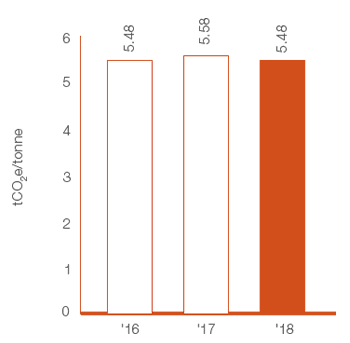
The CO2e generated per tonne of ferrochrome produced was 5.48tCO2e (2017: 5.58tCO2e) |
|
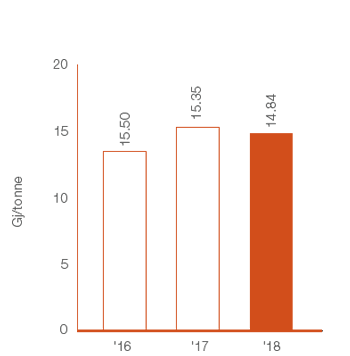
The energy use per tonne of ferrochrome produced was 14.84Gj (2017: 15.35Gj) |
Stakeholder impact
The Venture’s stakeholders benefit from its energy efficiencies, which have made it one of the lowest-cost ferrochrome producers in the world and the lowest-cost producer in South Africa.
Managing climate change and carbon emissions
The Venture focuses on understanding the current and future impact of climate change on its operations. Climate change risks are included in each operation’s risk assessment. It measures and interprets energy and greenhouse gas (GHG) data to identify areas of opportunity. The Venture continuously researches and identifies potential energy and GHG reduction opportunities and evaluates the feasibility of implementing these opportunities. It also actively participates in discussions on climate change legislation via various industry organisations.
The Venture’s efforts to continually evaluate and better its energy efficiency are in line with the societal demand to reduce the emissions of GHGs. It uses the Greenhouse Gas Protocol as an accounting and reporting standard for our emissions, which uses the factor of 1.009kgCO2 kWh. This protocol was developed in partnership with the World Resources Institute and the World Business Council for Sustainable Development. It divides GHG emissions into different types, categorising them as either direct or indirect emissions.
A representative of the Venture served on the council of the Energy Intensive User Group (EIUG) during 2018. The Venture, which chairs the Ferro Alloys Producers Association (FAPA) environmental forum, represents the ferroalloys industry at Business Unity of South Africa (BUSA). The Venture’s representatives play a leading role in these forums and they comment on climate change and carbon tax legislation. The Venture also engages with government via these forums to ensure that the potential impact that the proposed legislation will have on our industry and Company is understood.
During 2018, the Venture again played an important role in the engagement process, which took place between business and the National Treasury on the draft carbon tax paper. It also continued engaging with all members of FAPA to gain a common understanding of GHG emission factors for our sector and the calculation of the GHG emission footprint.
Climate change performance is included in the health, safety, environment and community performance indicators that the Venture uses as part of its performance appraisals.
The Glencore Alloys Group Environmental Manager is responsible for climate change-related issues in the Venture.
The Venture’s focus for 2019
The Venture will continue with its engagement processes and with identifying and further evaluating potential GHG mitigation projects.
While the Venture has not set any specific climate change targets for 2019, it will in future use the targets set as part of the Department of Environmental Affairs’ ("DEA") carbon budgeting process to guide its target setting processes.
Understanding the Venture’s carbon footprint
The Venture generates GHG emissions from its smelting processes and from its energy use. The use of fossil fuels in the form of diesel and petrol in vehicles contributes directly to the creation of GHGs, and the electricity supplied from coal-fired power stations contributes indirectly to the creation of GHGs.
The Venture and Merafe are committed to minimising GHG emissions and improving our energy efficiency, and recognise the magnitude and importance of this challenge. The Venture also actively engages in public policy, specifically through collaboration with the DEA on a carbon budgeting process aimed at estimating the country’s annual carbon emission.
The risks associated with climate change
Climate change remains a key longer-term risk for the Venture. The potential risks are complex in that they include operational risks such as business continuity, health and safety, environmental aspects and regulatory aspects. Risks are both physical and financial, for example should the Venture’s operations be damaged by flooding and extreme storms this could cause business interruptions. The reduced availability of water could also interrupt its business and could have health impacts.
 See the Stakeholder engagement table on our website for more information
on our stakeholder impact and engagement with government, our investors and
business partners.
The Venture’s energy consumption
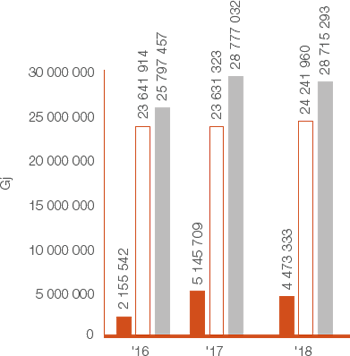
Total energy consumption in the Venture’s operations in 2018 was similar to 2017. The energy use per tonne of ferrochrome produced decreased from 15.35Gj/tonne to 14.84Gj/tonne.
| The Venture's energy usage | Energy use per tonne of ferrochrome produced | ||
 |
 |
||
Direct energy use Indirect energy use Total energy use |
Total energy use
|
||
The Venture’s emissions
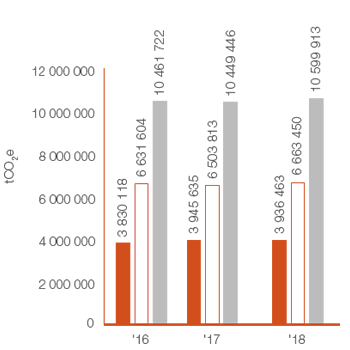
Venture’s total Scope 1 (direct) and Scope 2 (indirect) emissions in 2018 remained at similar levels as 2017 (10.5 million tonnes). The CO2e generated per tonne of ferrochrome produced decreased slightly in 2018.
| GHG emissions | CO2e generated per tonne of ferrochrome produced | ||
 |
 |
||
Scope 1 Scope 2 Total tCO2e generated |
Total tCO2e generated
|
||
The energy consumption and emissions performance of the Company in any year is dependent on the production performance in that year of the most energy-efficient plants in the Venture.
Natural capital: environment
KEY POINTS – 2018
The Venture’s total water usage marginally Water conservation plans in place at all operations |
There were no high-potential The Venture had no environmental fines, penalties or prosecutions |
Environment includes the natural resources and processes needed by an organisation to produce its products.
MATERIAL
ISSUES
- Water
- Gas emissions
- Waste
- Biodeversity and land use
As Merafe’s corporate office has a limited impact on the environment this section of our report focuses on the Venture’s environmental approach, impact and performance. We rely on the Venture’s effective environmental policies and procedures to ensure our investment is managed responsibly.
An integrated approach to environmental responsibilities
The Venture’s long-term success depends on prioritising environmental issues and integrating environmental responsibility into its strategic planning, management systems and day-to-day operations. Management accountability is central to Glencore’s integrated approach, which reviews its environmental risks and opportunities annually as part of its business strategy and planning process. Each site has a comprehensive environmental management system in place. The system provides access to aspects and the impact of all activities, from pre-feasibility to the operational phase, including closure and rehabilitation. The Venture’s objective is to ensure environmental legal compliance, optimise its monitoring and measurement practices and to minimise and manage any waste and emission generation in an environmentally responsible manner. Environmental responsibilities are clearly included into legal appointments and job descriptions.
Water
Water is a finite and precious natural resource essential to the sustainability of the communities in which the Venture works. It is also necessary for its mining and metallurgical processes.
Water use and availability
The Venture's operations work with the Department of Water and Sanitation ("DWS"), local communities, local authorities, the farming community and other industry users to ensure the sustainability of water resources and equitable access to water resources for stakeholders.
The availability of water is a key consideration when the Venture plans the expansion or construction of an operation. It uses the results of the environmental and social impact assessments ("ESIAs") it undertakes to guide its decision-making and to ensure it has the least possible impact on local water resources during the various phases of its projects.
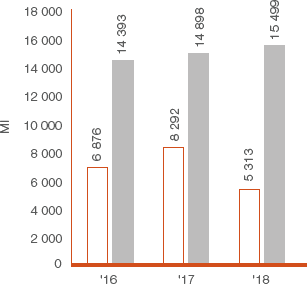
All the Venture’s operations have water conservation plans. They have previously set water intensity targets and have measures in place to help them be as water efficient as possible. In addition, its operations are identifying possible water reduction projects.
| The Venture's water usage |
|
 |
|
Water recycled or reused Total water consumption |
|
The water use in the Venture marginally increased in 2018 due to higher production levels.
Waste management and effluent and biodiversity management
The mineral waste produced by the Venture in 2018 was 4.3 million tonnes.
Mineral waste
| Category | 2018 tonnes |
2017 tonnes |
2016 tonnes |
2015 tonnes |
||
| Mineral waste – produced | 4 364 269 | 4 289 911 | 4 177 546 | 4 108 799 | ||
|---|---|---|---|---|---|---|
| Non-mineral waste – disposed | 15 041 | 14 396 | 9 279 | 10 803 | ||
| Non-mineral waste – recycled | 10 056 | 11 386 | 7 575 | 7 858 |
Incidents and compliance
is always the Venture’s aim to have no environmental incidents at its operations. It monitors, reports, investigates and remediates any incidents that occur and applies lessons learnt to prevent similar incidents in the future. Its operations are required to report any environmental high potential risk incidents ("HPRIs"), including near-misses, that could have resulted in a category 4 or 5 incident, even when the actual impact was less significant. Environmental incidents recorded at the Venture’s operations also include incidents that occur as the result of contractor activity.
The Venture has had no environmental fines, penalties or prosecutions at its operations for the past nine years. The Venture achieved its goal of no category 4 or 5 incidents recorded in its operations in 2018 and no category 4 or 5 incidents have been recorded in the Venture’s operations for the past nine years.
Environmental incidents
| 2018 | 2017 | 2016 | |||
| Category 1 – negligible (causing negligible, reversible environmental impact, requiring very minor or no remediation) | 52 | 50 | 61 | ||
|---|---|---|---|---|---|
| Category 2 – minor (causing minor, reversible environmental impact, requiring minor remediation) | 7 | 16 | 14 | ||
| Category 3 – significant (causing moderate, reversible environmental impact with short-term effect, requiring significant remediation) | 2 | 0 | 0 | ||
| Category 4 – major (causing serious environmental impact, with medium-term effect, requiring significant remediation) | 0 | 0 | 0 | ||
| Category 5 – disastrous (causing disastrous environmental impact, with long-term effect, requiring major remediation) | 0 | 0 | 0 |
NOx and SOx performance
The Venture's emissions
| Category | 2018 tonnes |
2017 tonnes |
2016 tonnes |
||
| NOx (oxides of nitrogen) Stack emissions (total mass) |
1 032* | 363 | 349 | ||
|---|---|---|---|---|---|
| SOx (oxides of sulphur) Stack emissions (total mass) |
4 273 | 3 458 | 3 796 | ||
| Total particulates | |||||
| Stack emissions (total mass) | 2 218 | 1 204 | 1 484 |
| The emission data is based on quarterly emission data which is used to calcualte emission factors and then applied to the year. | |
| * | The nature of the operations at the Ventures semi closed furnaces means that dilution air enters the air pollution control equipment. NOx is formed as a secondary emission through the air pollution control equipment due to the presence of nitrogen in the air. Small process changes in terms of gas volume and temperature can result in step changes in NOx emissions. Despite the variance from 2017 to 2018, emissions at the Venture do not exceed any ambient standards for NOx. |
Product stewardship
The Venture monitors and addresses the impacts and risks associated with the use of its products throughout their life cycles, including during stages outside of its control, such as use, recovery, recycling and disposal.
It works with national and international industry associations, its customers and suppliers to understand the environmental health and safety risks of its products and to find ways to mitigate these risks.
In terms of Registration, Evaluation and Authorisation and Restriction of Chemicals ("REACH"), all the products that the Venture exports to countries in the European Union have been pre-registered, with the relevant preregistration certificates and numbers available. The Venture is also actively involved in REACH.
No products produced by the Venture, or their packaging materials, were reclaimed during 2018.
To ensure the quality of its products, the Venture aligns its systems with the requirements of ISO 9001:2008 and some of its smelters are certified. Its laboratories are ISO 17025 accredited, which ensures that the methods and equipment it uses are accurate.
For further information on land use, see the Resources and Reserves Statement in
our online Integrated Annual Report for 2018.